

Author: Dustin

  • How Do I Make Time for the People Who Matter?

    How Do I Make Time for the People Who Matter?

    Pick one person and one specific time this week, then send the message today: a date and a time, not a vague “we should catch up.” A scheduled slot gets kept because it exists somewhere other than your intentions. Starting with one relationship, not your whole social life, is what makes the first step possible.

    A vague intention to “see people more” has no date attached to it, so it loses to anything with a deadline: a work email, a load of laundry, an episode you meant to finish. One name and one hour, written into your calendar, competes on the same terms as everything else that already fills your week.

    Why “I don’t have time” is usually not the real problem

    Most people find time for whatever they have already decided is non-negotiable. You do not forget to eat, answer your boss, or pick up your kid from school, not because those things take no effort, but because they are not optional in your head. Contact with people you care about often stays optional, which is exactly why it keeps losing.

    There is a real difference between no time and no decision. No time means every hour is already spoken for by something as important or more important. No decision means the hours exist, but nothing has claimed them yet, so whatever is loudest in the moment wins by default.

    Some seasons genuinely have almost no slack: a new baby, caregiving for a parent, two jobs to make rent. If that is your season, the honest move is a smaller ask of yourself, like a two-line text once a week, not a guilt trip about dinners you cannot host. This is not about being a better friend than your circumstances allow. It is about finding the smallest true version of staying in touch.

    Who actually matters to you? A 10-minute list that gets specific

    Write down eight to ten names right now, with no categories and no ranking. Not “family,” not “college friends”: actual names, the people you think of when you imagine a good year ahead.

    Next to each name, mark whether you have spoken to that person in the last month. Then write one short note: what you actually want with them. For some it is regular contact. For others it is one real conversation, not small talk. For a few, honestly, it might just be to stop feeling guilty about them, which is its own kind of answer.

    Look back at the list and notice which names you wrote out of obligation rather than want. That is not a verdict on those people. It is information about where your energy is going versus where you want it to go, and it will shape what you do next.

    Are you tired of being out of touch, or do you want something specific?

    “I never see anyone anymore” is an away-from statement: it names what you are sick of without saying what you are moving toward. Away-from statements are honest and useful as a starting point, but they do not tell you what to do on a Tuesday.

    Turn it around with one question: what would a good month with these people actually look like? Not “better,” not “more,” but a picture you could check against reality. “Be a better friend” cannot be scheduled or measured, so it rarely survives contact with a busy week.

    Try this one-sentence test: ninety days from now, I see [name] every [how often]. If you cannot fill in both blanks, you have not yet turned the wish into something you can act on. That is the whole move: away-from becomes toward the moment it gets specific enough to put in a calendar.

    What a realistic rhythm looks like when your week is full

    You do not need a free evening to stay in touch. A ten-second voice message, or a two-line text with an actual date in it (“Coffee Thursday at 8, you in?”) takes less time than scrolling past their name in your contacts.

    Combining works well too: a walk you were already going to take, a drive you were already making, an errand that has room for company. None of this requires new time, only a decision to not do it alone.

    A standing slot beats a spontaneous one when your week is full, because it does not need to be re-decided every time. Same evening, same week of the month, with the same person or group, removes the negotiation entirely. And before you part ways at the end of any visit, name the next date out loud. “Next time” with no date attached is how a year goes by.

    How much time you haveWhat that can look likeHow to set it up
    10 minutesA voice message or a specific text, not a check-in questionSend it before you open anything else on your phone today
    1 hourCoffee, a short walk, or a call while you cook or commuteName the day and time in the first message, then put it in your calendar
    Half a dayA standing monthly dinner, a weekend visit, a shared activityFix the same week of the month so it never needs re-deciding

    The question people avoid: what are you protecting the time from?

    Whatever currently fills that hour, work that quietly expands, scrolling, recovery time after a long day, saying yes to things you did not want, is the real competitor to seeing people, not a lack of hours in the day.

    Ask yourself one plain question: if I gave this hour to someone, what would I have to say no to? Naming that thing specifically is the real first step, more than any new habit or app. Vague willpower loses to a specific, named competitor every time; a decision does not.

    This is not an argument against rest. Recovery time is real and it matters. The point is to know what you are choosing when you choose it, rather than letting the hour disappear without a decision ever being made.

    What to do when reaching out feels awkward after a long silence

    Name the silence in one line and propose a date in the same message. “It’s been way too long, free for coffee next week?” does more work than a long apology, because it moves straight to something the other person can say yes to.

    Some contacts will not come back, and that is information, not failure. People drift for reasons that have nothing to do with how much they were valued: different cities, different seasons of life, time that simply ran out before anyone noticed.

    A low-stakes opening works better than a grand gesture: a shared memory, a simple question, an invitation with a concrete time attached. If what you feel is not awkwardness but a loneliness that does not lift, or an avoidance that feels bigger than scheduling ever could, that belongs with a doctor or a therapist, not with an exercise in an article.

    How this area connects to the rest of your life

    Contact with family and friends is one of eight areas in the wheel of life, alongside things like work, health, and money. Rating it honestly, both where it sits now and where you want it in ninety days, often says more than another conversation with yourself about “being better at relationships.”

    A low score here is frequently the result of a decision made somewhere else entirely: a job that eats evenings, a health issue that drains your energy, a move that put distance between you and the people you used to see easily. Seeing that connection is often more useful than trying harder at the relationships themselves.

    Coach Kontra’s free wheel of life takes about fifteen minutes, costs nothing, and keeps your result in your account so you can look back at it later. For a reader who sees this area sitting low, it is the honest next step before anything else.

    If you want to go further than one area, the course Know what you want works through this kind of thinking across three modules and fourteen short video lessons. Each lesson has an exercise you fill in, and an AI coach reads your answer and asks follow-up questions until it is clear, with the AI coach included for twelve months.

    Your first step in the next 24 hours

    Send one message today with a date and a time already in it. Not “we should catch up soon,” but “Tuesday at 7, you free?” The specificity is what makes it actionable instead of another good intention.

    Put the slot in your calendar before the reply even comes back. If they cannot make that time, you already have a slot you were willing to protect, and you can offer another one.

    Check in with yourself a week later: did it happen, and if not, what got in the way? That single honest question, repeated weekly, does more than any amount of planning up front. This is training in thinking clearly about your own time, not therapy, and it promises no particular outcome, only a clearer next step than the one you started with.

    Frequently asked questions

    How do I make time for friends when I work full time and have kids?

    Start with one person and one small, recurring slot rather than trying to rebuild your whole social life at once. A two-line text with a specific date, a walk you combine with an errand, or a call during a commute all count and take almost no extra time. A standing slot, like the same evening each month, works better than waiting for a free weekend that rarely comes.

    How often should I see friends and family to stay close?

    There is no fixed number that applies to everyone; what matters more is that contact is regular enough that neither of you has to wonder when you will next speak. A short message every week or two can keep a connection alive even when an in-person visit only happens a few times a year. The right rhythm is the one you can actually keep, not the one that sounds ideal.

    What do I say to a friend I have not spoken to in a year?

    Name the gap in one honest line and offer a specific date in the same message, such as "It's been way too long, are you free for coffee next week?" A short, direct message works better than a long apology, because it gives the other person something concrete to respond to. If they do not reply, that is information about where things stand now, not a judgment on the friendship you had.

    Is it normal to lose friends in your thirties and forties?

    Yes, it is common for social circles to shrink or shift as jobs, moves, and family responsibilities change through these decades. This usually reflects changing circumstances rather than something wrong with you or the friendship itself. Noticing which relationships you want to actively keep is a more useful question than comparing your social life to anyone else's.

    How do I stop cancelling plans at the last minute?

    Cancelling often happens when a plan was made vaguely and without a clear decision behind it, so it loses easily to tiredness or a better offer. Naming exactly what you are protecting the time from, before you cancel, makes the trade-off visible instead of automatic. A standing, recurring slot with the same person also tends to survive busy weeks better than a one-off plan does.

    What if I do not actually want to see the people I feel obliged to see?

    That is useful information, not a character flaw, and it is worth writing down honestly rather than ignoring. A list of the people who matter to you, made without obligation in mind, often looks different from the list of people you feel you should see. It is reasonable to let some contact stay occasional or minimal if that is genuinely what both of you want.

    Not sure what you want yet?

    The free wheel of life takes about fifteen minutes. You rate eight areas of your life, see where the gap is and keep the result. It is the first step of the course Know what you want, and it costs nothing.

    Start the free wheel of life

    This article was written with AI assistance and checked by Dustin van de Sande.

    Ready to work on what you want?

    Start with the free wheel of life: in fifteen minutes you see where you are and where you want to go. Want to turn that into a goal you will keep, with an AI coach? See the course Know what you want.


  • How to Grow as a Person When You Only Know What You’re Tired Of

    How to Grow as a Person When You Only Know What You’re Tired Of

    Personal growth starts smaller than people think: name one area of your life, name the complaint that keeps repeating there, turn it into one thing you want instead, and take a step you can finish in under thirty minutes within the next day. This is training in thinking clearly, not therapy, and it works through actions you can point at rather than a feeling of becoming a new person.

    What does it actually mean to grow as a person?

    Growth is a change in how you choose and act, not a change in how you feel about yourself on a given morning. You can feel the same and still be growing, because growth shows up in behavior: a conversation you finally had, a thing you stopped automatically saying yes to, a question you asked instead of staying quiet.

    It starts by naming one area of your life, work, money habits, friendships, health, and one thing you want more of there. That’s the whole starting move. Everything else in this article is one way to do that naming well.

    One honest note before anything else: this is training in thinking clearly and choosing on purpose. It is not therapy, and it is not built to treat anything a doctor or therapist would treat.

    Why ‘be a better person’ is too big to act on

    Vague goals like being more confident or more disciplined give you nothing to do on Tuesday morning. You can agree with the goal completely and still have no idea what to do when you wake up, because a trait is not a step.

    Most popular advice lists repeat this problem: leave your comfort zone, think positive, stop being a perfectionist. These describe a kind of person you’d like to be, not an action you could take in the next ten minutes. That gap is why so much of this advice gets nodded at and then ignored.

    The unit that actually moves is one area of life at a time, not your whole self at once. Pick one area, not eight, and you suddenly have something you can act on this week instead of a personality to overhaul.

    None of this works through comparison. Measuring yourself against someone who seems to have it together is not fuel, it’s just a new way to feel behind. Leave other people out of it.

    Vague growth goalWhat it looks like as a first step this week
    Be more confidentAsk one question out loud in Thursday’s meeting
    Stop procrastinatingWork on one task for twenty-five minutes with your phone in another room
    Be more presentPut your phone outside the bedroom one night this week
    Set better boundariesSay no to one specific request you’d normally accept
    Get healthierWalk for fifteen minutes after dinner three times this week
    Be less of a perfectionistSend one piece of work you’d normally hold back for another round

    Start with the one question most growth advice skips

    The question is: in which part of my life does the same complaint keep coming back? Not which part needs fixing, not which part everyone says you should work on, the one where you notice yourself having the same frustration on repeat.

    Write the complaint down in one sentence. Say it out loud first if that makes it easier to catch the real wording instead of a polished version.

    Set a timer for ten minutes, no phone, one sheet of paper. Write whatever complaint surfaces first, even if it sounds petty or you’ve said it a hundred times before.

    It is completely normal that the first honest answer is a complaint rather than a wish. Most people know what they’re tired of long before they can name what they want instead, and that’s the actual starting point, not a failure to have a goal ready.

    How do I turn ‘I’m tired of this’ into something I actually want?

    Write the complaint, then ask yourself: and what do I want instead? Keep asking until the answer is stated as something present, not as the absence of the old thing.

    If the answer keeps coming back as not that, get concrete: what would be happening instead on a normal Wednesday? What would you be doing, saying, or not saying, at 9am on an ordinary day if this were already true?

    From there, ask and what would that give me? two or three times. This question, borrowed from practical thinking tools rather than any claim of proven science, usually surfaces the goal behind the goal, the thing the first answer was actually standing in for.

    Here’s an imagined example to show the shape of it. Someone writes: I’m tired of my calendar being full of other people’s meetings. Asked what they want instead, they land on: I want two hours a day where nobody can book me. Asked what that would give them, they land on: time to actually think before I react. That’s a different, more usable target than the original complaint, and it came from the same three questions anyone can ask themselves.

    Which area of your life do you start with?

    Start with the area that has the biggest gap between where it is now and where you want it in ninety days, not necessarily the one scoring lowest today. A low score you’ve made peace with can matter less than a middling score that’s drifting the wrong way.

    One way to see that gap clearly is a wheel of life: you rate eight areas of your life now and where you want each of them in ninety days, then look at where the distance is largest. Coach Kontra’s free wheel of life does exactly this, takes about fifteen minutes, needs no payment, and keeps the result in your account so you can come back to it.

    The five-step version you can run this week

    Here is the sequence in order, usable starting today:

    1. Name the area of life you’re starting with.
    2. Name the complaint, in one plain sentence.
    3. Flip it: ask what you want instead until the answer is stated positively.
    4. Write one sentence describing ninety days from now, as if it’s already true.
    5. Take one step within twenty-four hours.

    A first step is something you can finish in under thirty minutes: one email, one question asked, one fifteen minute walk, one sign-up. If it takes longer than that to even start, it’s not a first step yet, it’s a project disguised as one.

    Set a weekly check-in at a fixed time, ten minutes, same day each week, to look at what you actually did against what you said you’d do. If you miss a step, move it to the next day rather than restarting the whole plan. A missed Tuesday doesn’t erase Monday’s thinking.

    What a first step looks like when you have twelve ideas

    Pick the idea you’d be relieved to have already started, not the one that scores highest on paper. Relief points at what you actually want to be moving on, where best-on-paper often just points at what sounds good to say out loud.

    Park the other ideas in writing, somewhere specific, so they stop quietly taking up room in your head while you’re trying to focus on one. Writing them down is often enough to stop the low hum of should I be doing that instead.

    Give the one idea you picked two weeks of real attention before judging whether it’s working. Switching after three days tells you almost nothing except that you switched.

    A wish on its own changes nothing, no amount of wanting something rearranges your week by itself. The step is the actual test of whether this is worth more of your time, not how much you want it in the abstract.

    How do I know if I actually want this, or just think I should?

    Ask: who would be disappointed if I dropped this? If the honest answer is only other people, a parent, a former version of yourself, a vague sense of what’s expected, look at the goal again before investing more time in it.

    Notice which values keep showing up across your answers, two or three words like independence, craftsmanship, or fairness tend to repeat once you’re looking. Those words are often a better compass than any single goal.

    Pay attention to should, always, and never in your own sentences. I should want this, I always do this, I never get to that, these words usually hide an assumption worth questioning rather than a fact worth obeying.

    Wanting something you can’t fully explain to anyone else is allowed. Not every goal needs to survive a cross-examination from people who didn’t ask for one.

    What daily habits actually support growth (and which ones just feel productive)

    A ten minute daily review beats an elaborate morning routine you quietly abandon by week two. Consistency at a small size outperforms intensity that collapses under its own weight.

    Write one line a day: what did I decide today? It’s a smaller habit than a journal and a more honest one, because it tracks choices instead of moods.

    Ask for support out loud from one specific person, rather than announcing a plan to everyone you know. One person who knows the actual step you’re taking this week is more useful than an audience.

    As an Amazon Associate we earn from qualifying purchases. Some links in this article are affiliate links: if you buy through them we earn a small commission, at no extra cost to you.

    This brand doesn’t claim affirmations or visualizing change outcomes, because a wish stated to a mirror doesn’t move a calendar. What it teaches instead is naming the area, naming the want, and taking the step, in that order, repeatedly. For readers who want more on habit mechanics specifically, Atomic Habits is a reasonable next read.

    When growth work is not the right tool

    Depression, anxiety disorders, trauma, and burnout belong with a doctor or a therapist, and if you’re having thoughts of self-harm, that’s also where to go, not to a goal-setting exercise. No exercise on this site is a treatment, and none of it is a substitute for professional care.

    You can do both at once. A therapist or doctor for care, and this kind of direction-finding work for the question of what you want your days to look like once you’re steadier. They’re not competing tools, they answer different questions.

    Where to go next with this

    The honest next step for most readers is the free wheel of life: about fifteen minutes, no payment, and it tells you which of eight areas has the biggest gap worth starting with.

    From there, the course Know what you want goes further: three modules, fourteen short video lessons, and an exercise built into every lesson. An AI coach reads what you write and asks follow-up questions until your answer is actually clear, you can change an answer and ask for feedback again, and the AI coach stays included for twelve months after you start the course.

    Frequently asked questions

    How do I become a better person inside and out?

    Start with one area of your life and one specific behavior you want to change there, rather than aiming at your whole character at once. Growth shows up as actions you can point at, a conversation you had, a request you declined, not as a general feeling of being improved. Pick one area, name the complaint, and take a step within a day.

    What are some good daily habits for self-improvement?

    A short daily review, around ten minutes, tends to outlast an elaborate morning routine that gets abandoned within a few weeks. Writing one line a day about what you decided keeps you tracking choices instead of moods. Asking one specific person for support, rather than announcing a plan broadly, also tends to hold up better over time.

    How long does it take to see personal growth?

    There's no fixed timeline, because growth is measured in actions taken, not days elapsed. You can often point to a changed behavior within a week of naming the area and the first step. Give any single approach about two weeks of real attention before judging whether it's working for you.

    How do I change my life for the better when I don't know what I want?

    Start with what you're tired of, since that's usually clearer than what you want, and turn it into a direction by asking what you want instead until the answer is stated positively. A free tool like the wheel of life can help you see which area of life has the biggest gap to start with. The step from there matters more than having the perfect answer first.

    Can I grow as a person without setting goals?

    Yes, you can grow through small repeated decisions without writing a formal goal, as long as those decisions are intentional and you can name what changed. A goal simply makes the direction easier to check yourself against. Either way, the test is still whether your actions changed, not whether you wrote something down.

    Is personal growth work the same as therapy?

    No, personal growth work like naming a goal or taking a first step is training in thinking clearly and choosing on purpose, not therapy. It does not diagnose or treat conditions like depression, anxiety, trauma, or burnout, which belong with a doctor or therapist. The two can work alongside each other for different purposes.

    Not sure what you want yet?

    The free wheel of life takes about fifteen minutes. You rate eight areas of your life, see where the gap is and keep the result. It is the first step of the course Know what you want, and it costs nothing.

    Start the free wheel of life

    Sources

    This article was written with AI assistance and checked by Dustin van de Sande.

    Ready to work on what you want?

    Start with the free wheel of life: in fifteen minutes you see where you are and where you want to go. Want to turn that into a goal you will keep, with an AI coach? See the course Know what you want.

  • How to Make Time for Fun and Rest When You Are Busy and Still Stuck

    How to Make Time for Fun and Rest When You Are Busy and Still Stuck

    You do not find time for fun and rest, you decide what counts as rest and fun for you and protect one small block before the week fills in. Most people know what drains them but not what restores them, which is why generic activity lists do not stick.

    What is the honest answer to “how do I make time for fun and rest”?

    You do not find time for fun and rest, you decide what they mean for you and protect one small block before the week fills in around it. Most people can name what drains them but not what restores them, which is why generic lists of relaxing activities do not stick.

    Fun and rest are different needs, and mixing them up is why a full weekend can still feel empty. Rest lowers how loaded you feel. Fun raises how interested you feel. A weekend of errands and background television can do neither, even if every hour is technically free.

    This is not a time management problem first. It is a decision problem. If you cannot say what actually restores you, no amount of free time will land as rest, and no calendar trick will fix that. The fix starts with naming it, not with finding more hours.

    None of this promises a new life. It is one small decision, repeated often enough that it becomes ordinary.

    Why do I struggle to have fun, even when I have the time?

    People report a few common reasons: little practice at choosing for themselves, guilt about time that is not producing anything, decision fatigue by the end of the day, and a quiet habit of waiting to earn rest before taking it.

    Fun that has to be useful stops being fun. A lot of advice turns leisure into “productive leisure,” a walk that has to be a workout, a hobby that has to become a side income. The moment fun needs to justify itself, it quietly stops being fun.

    There is also a trap worth naming directly: knowing you are tired of scrolling at night is not the same as knowing what you actually want instead. “Away from” is easy to describe. “Toward” takes more thought, which is exactly why most people stop one step short of it.

    One honest line here: if nothing has felt enjoyable for weeks, or you feel flat most days regardless of what you try, that is worth raising with a doctor or a therapist. An exercise in an article is not built to carry that, and it should not try to.

    What is the difference between rest, fun and just not working?

    Rest lowers your load. Fun raises your interest. Numbing does neither, it only passes time. These are three different things, and most weeks quietly default to the third without anyone deciding that on purpose.

    A simple test: after an hour of whatever you are doing, do you feel lighter, heavier, or exactly the same as before you started? Lighter points to rest. Livelier or more awake points to fun. The same, or slightly heavier, usually points to numbing.

    Scrolling, background television, and half-working while half-resting tend to land in that third column for a lot of people. That is not a moral failing, it is just useful information about what an activity is actually doing for you.

    What you are doingWhat it gives youHow you feel after an hour
    Resting on purposeLowers your loadLighter
    Doing something funRaises your interestLivelier, more awake
    Numbing outPasses the timeThe same, or heavier

    You do not have to give anything up to run this test. You only have to notice, honestly, how you feel an hour in. That one habit of noticing tells you more than any list of recommended activities.

    The 10-minute question that shows what rest actually works for you

    Write down three times in the last year you felt genuinely rested or genuinely amused, as specifically as you can. Where were you, who were you with or were you alone, and roughly how long did it last.

    Then look for the common factor across the three. Were you alone or with people? Moving or still? Something planned in advance or something that happened by chance? Indoors or outside? The pattern matters more than any single memory.

    Finish with one sentence each: “I rest best when ___” and “I enjoy myself most when ___.” Fill in the blank with the specific pattern you found, not a general idea.

    Short, specific memories beat big ideas like “a holiday.” A holiday is too large and too rare to plan around every week. A quiet half hour with a book before anyone else is awake, or an hour outside with one particular friend, is small enough to actually repeat.

    How do I put it in the week without adding another project?

    Pick one block of 30 to 60 minutes in the next seven days and name the activity exactly. Not “relax,” but what you actually wrote down in the exercise above: reading on the porch, a specific walk, a call with one particular person.

    Protect that block the way you would protect a meeting with another person. If something else wants that slot, it goes somewhere else, the same way you would not casually cancel on a colleague.

    Pair it with something already fixed in your week so it does not need willpower to remember. Right after Thursday’s last call. Before Sunday dinner starts. The anchor does the remembering for you.

    Expect to miss one eventually, and move it instead of cancelling it outright. A missed block is a normal week, not proof the plan does not work.

    What do I do when guilt shows up the moment I stop?

    Guilt about rest is common, and it is not proof that you are lazy. A lot of people carry a quiet rule that rest has to be earned first, and that rule rarely gets questioned out loud.

    Give the block a clear start and end time so it has edges and does not leak into the rest of your evening, which is often what the guilt is actually worried about. An hour with a stop time behaves differently than an open-ended hour.

    Ask yourself directly: what am I afraid will happen if I stop for an hour, and has that actually happened before? Most of the time the honest answer is that nothing happened the last time you stopped, the fear is just loud, not accurate.

    If the guilt or worry does not ease and runs through most of your days regardless of what you try, say so plainly to yourself: that is a conversation for a doctor or a therapist, not something an article or an exercise is built to resolve.

    Where does fun and rest sit next to the rest of your life?

    Fun and relaxation is one of the eight areas most people look at when they take stock of a life in broad strokes, sometimes called the wheel of life. Rating that one area now, and where you want it in ninety days, turns a vague complaint into one number you can actually act on.

    Often a low score here is quietly paid for by another area. Work expands into the evening, health routines slip, or time with people you care about gets pushed to “later” so often that later stops arriving.

    A free wheel of life rating takes about fifteen minutes, costs nothing, and the result is kept in your account so you can return to it. If you are not sure where to start with any of this, that fifteen minutes is a reasonable place to begin, and it works for every area, not only fun and rest.

    A first step you can take in the next 24 hours

    Within the next 24 hours, four small actions turn this from an idea into something real:

    1. Name one activity exactly, using what you found in the 10 minute exercise, not a general word like “relax.”
    2. Pick one time block in the next seven days and attach it to something already fixed in your week.
    3. Tell one other person about the block, the same way you would mention a meeting.
    4. Set a weekly check in with yourself to ask whether the block actually happened and how you felt an hour in.

    None of this is a method for a new life. It is a way of stopping this one area from being left to whatever time happens to be left over, which is usually none.

    If what is really underneath this is a bigger question, something closer to “I am tired of how my week looks” than “I need an hour on Thursday,” the course Know what you want works through exactly that, turning what you are tired of into a goal with a first step. It has three modules and fourteen short video lessons, with an exercise inside every lesson that an AI coach reads and asks follow-up questions about until the answer is actually clear, included for twelve months with the course.

    This is training, not therapy. If low mood, constant guilt, or flatness run through most of your days and do not ease on their own, that belongs with a doctor or a therapist, not with a course or an exercise.

    Frequently asked questions

    Why do I struggle to have fun?

    Common reasons people report are little practice at choosing for themselves, guilt about unproductive time, decision fatigue by evening, and waiting to earn rest instead of simply taking it. Fun that has to justify itself as productive usually stops feeling like fun. If this has gone on for weeks and nothing feels enjoyable, that is worth raising with a doctor or therapist rather than solving with an exercise.

    How much time do I need for rest to actually count?

    There is no fixed minimum, but a block with a clear start and end, even 30 minutes, tends to register as rest better than unstructured free time that leaks into other things. What matters more than the length is whether you feel lighter afterward, not heavier or the same. A protected 30 minutes often beats an unprotected two hours.

    What can I do at home when I only have an hour?

    Use the hour for whatever you wrote down as your answer to "I rest best when ___" or "I enjoy myself most when ___" from your own specific memories, not a generic list. Set a clear start and end time so the hour has edges. Notice afterward whether you feel lighter, which tells you it worked, rather than just full.

    Is scrolling on my phone rest?

    For most people, no: scrolling tends to pass time without lowering mental load or raising genuine interest, which is the simple test for rest and fun. It often leaves people feeling the same or slightly heavier after an hour, not lighter. That does not make it a moral failure, it just means it is doing something different than what you may be looking for.

    What if I plan time for fun and then do not use it?

    Expect to miss one scheduled block occasionally and move it to another time rather than cancelling it outright. Missing it once is not proof the plan does not work, it is just a normal week. Pairing the block with something already fixed in your schedule, like right after a regular meeting ends, makes it easier to actually use.

    Should I plan fun and rest or leave it spontaneous?

    Plan one small block, but let what you do inside it stay loose rather than overplanned. A fixed time with a flexible activity tends to actually happen, while waiting for the right spontaneous moment often means it never arrives at all. You can always adjust the activity on the day, as long as the block itself is protected.

    Not sure what you want yet?

    The free wheel of life takes about fifteen minutes. You rate eight areas of your life, see where the gap is and keep the result. It is the first step of the course Know what you want, and it costs nothing.

    Start the free wheel of life

    This article was written with AI assistance and checked by Dustin van de Sande.

    Ready to work on what you want?

    Start with the free wheel of life: in fifteen minutes you see where you are and where you want to go. Want to turn that into a goal you will keep, with an AI coach? See the course Know what you want.

  • How to Make Your Home Feel Better (Start With One Question, Not a Shopping List)

    How to Make Your Home Feel Better (Start With One Question, Not a Shopping List)

    Your home feels better when the way it looks and works matches what you actually do there and what you want from it. Start by naming the one thing that bothers you most, then change one small part of it today. New decor helps, but it sticks longer once you know what you want the room to be for.

    Most of the bad feeling in a home comes from three places: clutter and friction that cost you small decisions all day, a room that does not match how you actually live, and something from outside the house, work, money, a relationship, leaking into the way the rooms feel. A new rug does not fix the third one. This article is self-development content, not therapy, and it will say so again where it matters.

    Why does my home feel off when nothing is actually wrong with it?

    A tidy, pleasant house can still feel wrong if nothing in it reflects a choice you made on purpose. You can own good furniture, clean floors, and a working kitchen, and still walk in and feel flat, because the place was assembled rather than decided.

    Look for the friction points first: the chair nobody sits in, the spare room that quietly became a storage unit, the counter that collects mail, keys, and everything else that has no other home. None of these are dramatic. They are just small decisions you never got around to making.

    If the heaviness follows you everywhere, not just at home, and it has lasted for weeks, that is a matter for a doctor or a therapist, not a furniture decision. Being busy and behind on your house is ordinary. It is not a character flaw, and it is not a sign anything is wrong with you.

    The 10-minute walkthrough: how do you find out what is bothering you?

    Set a timer for ten minutes and walk through every room in your home, including hallways. In each one, write a single sentence: what do I feel when I walk in here. Do not edit the sentence, just write what comes first.

    Mark each room with one word: calm, neutral, or draining. Most homes have at least one room in each category, and that is normal.

    Pick the single room with the strongest reaction, not the easiest one to fix. The guest room that is now storage might be easier to tidy than the living room you avoid after 7pm, but the living room is the one actually costing you something every day.

    For that one room, write the fix you would make if you had fifteen minutes. Then sit with this question: what is this room for, and is that what it is actually being used for?

    What bothers you about the roomWhat it usually meansOne thing to try today
    Surfaces are always covered in stuffNothing in the room has an assigned placeClear one surface completely and decide where each item belongs
    The room feels dim or gray at nightOverhead light only, no light at eye levelAdd one lamp you turn on instead of the ceiling light
    You avoid sitting or working in this roomThe room is set up for something you do not actually do thereMove or remove the one piece of furniture that does not fit your actual use
    You have to walk around furniture to cross the roomThe path through the room was never plannedShift one piece so there is a clear line from door to door
    Something in the room irritates you but you cannot say whyYou have stopped seeing an object you never likedRemove it and notice if the room feels lighter

    What is one change you can make today in under twenty minutes?

    Pick one of these and finish it today. The point is one change completed, not five started.

    1. Clear one horizontal surface completely and keep it clear for a week.
    2. Move one piece of furniture so there is a clear path through the room.
    3. Change the light in the room you use after dark: one lamp at eye level instead of the overhead light.
    4. Remove one object you have stopped seeing but do not actually like.
    5. Put one thing you genuinely care about somewhere you will actually see it.

    If the room you use after dark only has an overhead light, a simple lamp placed at eye level, on a side table or shelf, usually does more for how the room feels than any amount of rearranging. The fixture itself matters less than where the light sits in the room.

    Why do decorating tips stop working after a week?

    A tip borrowed from someone else’s house solves their problem, not yours. A styling trick that made a stranger’s living room feel calm assumed a life, a budget, and a set of habits that are not the same as yours.

    Buying something new is faster than deciding what a room is for, which is exactly why most people buy. A new throw pillow takes five minutes. Deciding that the living room is for reading and not for a home office you never use takes longer, and it is the decision that actually matters.

    This is the same trap that shows up in most goal setting: knowing what you do not want is not the same as knowing what you do want. You can list everything wrong with a room for an hour and still not know what you want it to feel like instead. Knowing you hate the clutter on the counter does not tell you what the kitchen is actually for.

    Turn it around with one sentence. Write: ‘I want this room to be the place where I ___.’ Fill in the blank with something specific, read quietly after dinner, get dressed without tripping over laundry, have one real conversation a week. That sentence gives you a direction to decorate toward, instead of a list of complaints to decorate away from.

    What are the signs your home is working against you?

    A few behavioral patterns are worth noticing, and none of them require a diagnosis to name. You avoid a room entirely, or you only ever use one corner of your home even though you have more space than that. Nothing in the house has a fixed place, so every object, every day, costs you a small decision about where it goes. You find yourself apologizing for your home before anyone walks in, even when it is not actually messy. Or you cannot do the thing you say you want to do there, read, work, host people, because the space is still set up for something else entirely.

    None of these are judgments on you. They are just signs that the house and the life have drifted apart, and that is worth looking at directly rather than papering over with a new throw pillow.

    What this article does not cover, and should not, is mold, damp, pests, or air quality. Those are matters for a landlord, a building inspector, or a doctor, not a decorating decision, and no amount of rearranging furniture addresses them.

    How does your home fit into the rest of your life?

    Home is one of eight areas commonly used in a wheel of life exercise, alongside things like work, health, and relationships, and rating it next to the others shows whether the house itself is the problem or just where another problem is showing up. A home can feel unbearable for reasons that have nothing to do with the home.

    As an illustration: imagine someone whose living room feels unbearable mostly on the evenings after a long, draining workday, and perfectly fine on a slow Saturday morning. The room has not changed between Tuesday night and Saturday morning. What changed is what they are carrying into it. For that person, no amount of rearranging the living room touches the actual source.

    A wheel of life exercise asks you to rate each of the eight areas twice, once for where it stands now and once for where you want it in ninety days. The gap between those two numbers, for home specifically, is usually the thing worth working on, not the room’s appearance. The free wheel of life takes about fifteen minutes, costs nothing, and the result is kept in your account so you can look back at it later.

    What question should you sit with this week?

    Sit with this question: if this home were set up for the life I actually want in ninety days, what would be different about it? Do not try to answer the whole house at once. Pick the one room from your walkthrough with the strongest reaction, and answer for that room only.

    Once you have an answer, pick the smallest version of it and do it within twenty-four hours. Not the full renovation, not the complete reorganizing project, just the first fifteen-minute piece of it. Then set one weekly check-in, a recurring reminder, a note on the calendar, to walk back into that same room and ask whether the change held and what, if anything, to try next.

    As an Amazon Associate we earn from qualifying purchases. Some links in this article are affiliate links: if you buy through them we earn a small commission, at no extra cost to you.

    If you can describe exactly what you are tired of in your home but still cannot say what you actually want from it, that gap is the exact thing Know what you want was built for. It is a short course with three modules and fourteen short video lessons, each with an exercise you fill in inside the lesson, and an AI coach that reads your answer and asks follow-up questions until it is clear, included for twelve months with the course. For a fuller look at the thinking behind the room-by-room approach here, The Life-Changing Magic of Tidying Up covers a related idea from a different angle, deciding what a space is for before deciding what stays in it.

    This is training, not therapy, and so is everything else on this site. One room, one honest sentence, one small step within a day, and a check-in a week later. That is the whole method.

    Frequently asked questions

    Why am I unhappy in my home?

    Usually it is one of three things: clutter and friction that cost you small decisions all day, a room set up for a life you do not actually live, or something from outside the house, like work stress, leaking into how the rooms feel. A 10-minute walkthrough of each room, writing one sentence about what you feel there, usually shows you which one it is. If the unhappiness follows you everywhere and has lasted weeks, that is worth bringing to a doctor or therapist rather than a decorating project.

    What is the 3-5-7 rule in decorating?

    The 3-5-7 rule is a common decorating guideline, often used by interior decorators, for grouping objects such as books or vases in odd numbers, typically three, five, or seven items, because odd-numbered groupings tend to look more visually interesting than even ones. It is a styling convention, not a scientific finding. It can help you arrange a shelf, but it will not tell you what a room is for.

    How do I make my house feel happier without spending money?

    Clear one surface completely, move one piece of furniture to open up the path through a room, or put one object you genuinely care about somewhere visible. All three take under twenty minutes and cost nothing. The goal is finishing one small change rather than starting several.

    How long does it take for a new place to feel like home?

    There is no reliable, checkable number for this, and it varies a lot by person and situation. What people commonly report is that a place starts to feel like home once their daily routines settle into it and a few rooms reflect choices they made on purpose, not a fixed number of weeks or months.

    What are the signs of an unhealthy home?

    Behavioral signs include avoiding a room or only using one corner of your home, apologizing for your home before anyone walks in, and not being able to do the thing you say you want to do in a space because it is set up for something else. Physical issues like mold, damp, pests, or air quality are a matter for a landlord, inspector, or doctor, and this article does not cover them.

    Should I move, or fix how my home feels first?

    Try the fix first: a 10-minute walkthrough and one finished small change often reveal whether the house itself is the problem or whether something else, like stress leaking in from work, is the real source. Moving is a large decision that deserves a clear reason, and most people find that reason only after they have separated the house from the rest of their life.

    Not sure what you want yet?

    The free wheel of life takes about fifteen minutes. You rate eight areas of your life, see where the gap is and keep the result. It is the first step of the course Know what you want, and it costs nothing.

    Start the free wheel of life

    This article was written with AI assistance and checked by Dustin van de Sande.

    Ready to work on what you want?

    Start with the free wheel of life: in fifteen minutes you see where you are and where you want to go. Want to turn that into a goal you will keep, with an AI coach? See the course Know what you want.

  • Too Many Ideas and None Finished? How to Pick One and Start Today

    Too Many Ideas and None Finished? How to Pick One and Start Today

    You can’t choose because you have no clear way to decide, not because the ideas are equally good. Ask which idea you’d still want in ninety days if nobody ever knew you did it, score the top two on pull, cost, and how soon you can test them, then pick and take one small step within 24 hours.

    Why can’t you choose when you have too many ideas?

    You’re not stuck because your ideas are all equally strong. You’re stuck because you have no standard for choosing between them, so every option stays open and none of them gets a real test.

    Keeping five ideas alive at once splits your attention five ways. None of them gets enough time or energy to show you whether it actually works, so you keep circling back to pick a new one instead of finishing an old one.

    Overthinking a decision is usually not a thinking problem. It’s often fear of picking wrong dressed up as more research, more comparing, more waiting for certainty that isn’t coming.

    Choosing one idea now does not delete the others. It just means one of them gets your full attention for a while, which is the only way you’ll ever know if it’s worth more of your time.

    Are your ten ideas actually one want wearing different clothes?

    Many long idea lists are really one want showing up in different outfits. The fastest way to see this is to ask, of each idea: what would having this actually give me?

    Ask that question two or three times in a row. The first answer is usually surface level, something like money or recognition. Keep asking what that would give you, and you often land on something plainer: freedom, respect, calm, or the chance to make something with your hands.

    This kind of repeated questioning is a practical thinking tool used in coaching practice, not a proven scientific method. It works because it slows you down enough to notice a pattern you already knew but hadn’t said out loud.

    A common pattern: three or four of your ideas serve the exact same underlying want. The side business, the course, and the move to a new city might all really be about wanting more say over your own time.

    Try this now: write down five ideas, one per line. Under each, write one sentence answering what having that idea would actually give you. Read the five sentences together and see how many repeat.

    What question picks the idea for you in ten minutes?

    Ask yourself: which of these would I still want in ninety days if nobody ever knew I did it? Give yourself ten minutes, a pen, and no research, and write your answer before you second-guess it.

    Ninety days works better than ‘for the rest of my life’ because a lifetime is too abstract to feel. Ninety days is close enough to imagine clearly and far enough to separate a real want from a passing mood.

    Removing the audience is the other half of the question. Plenty of ideas only survive because you imagine telling someone about them. Take away the telling, and you find out which ideas you actually want for yourself.

    Set a timer for ten minutes. No looking things up, no opening a new tab to check if someone else has done it already. Just the question and your answer.

    How do you score ideas without turning it into another project?

    Use three columns only: pull (how much you want it), cost (what it takes this month), and proof (can you test it in a week). Score each one 1 to 5, with no weighting and no formula to build.

    If two ideas tie after scoring, the rule is simple: pick the one you can test soonest. Speed of feedback matters more than certainty, because a week of real information beats another month of guessing.

    Cap the whole exercise at fifteen minutes for your full list. If you’re still adjusting scores after that, you’ve turned a decision tool into a new project, which is exactly the trap this is meant to avoid.

    IdeaPull (1-5)Cost this month (1-5)Test in a week?
    Illustration: start a weekend pottery habit42Yes
    Illustration: launch a side consulting offer54No

    What if you keep picking and then switching a week later?

    Set a fixed trial length before you start, two weeks or thirty days, and write down exactly what you’ll look at when the trial ends. A trial with no end date and no measure is just another open option.

    Switching after a week is almost never new information. It’s usually discomfort arriving right on schedule, the same discomfort that would show up with any idea once the novelty wears off.

    Two honest signals mean a switch is right rather than restless: the want behind the idea has genuinely changed, or the first real test showed you something you didn’t expect and couldn’t have known in advance. Boredom alone is not one of these signals.

    Write your stop condition down before you begin, in plain terms: ‘I’ll stop if X happens’ rather than ‘I’ll stop if I feel like it.’ That way the decision gets made by what actually happened, not by your mood on a bad Tuesday.

    How do you turn the chosen idea into a goal you can start today?

    Once you’ve picked, write one sentence that names what you want, by when, and how you’ll know you got it. A goal that can’t be checked against reality isn’t a goal yet, it’s still an idea.

    1. Pick the idea that came out ahead from the ninety-day question or the scoring pass.
    2. Write one sentence: what you want, by when, and how you’ll know.
    3. Name a first step small enough to finish in under thirty minutes.
    4. Do that step within 24 hours of writing the sentence.
    5. Set one weekly check-in time on your calendar and keep it.

    Imagine someone who picked ‘learn to cook three meals well’ out of a list of eight ideas. Their one sentence: ‘I’ll be able to cook three meals from memory by the end of next month, tested by cooking all three for someone else without a recipe in hand.’ Their first step: buy the ingredients for meal one, nothing more.

    Tell one other person what you picked. Saying it out loud to someone who might ask about it later makes ‘maybe later’ a harder sentence to say to yourself.

    Where do the other ideas go so they stop pulling at you?

    Keep one list, in one place, dated, and look at it again at your weekly check-in. Parking an idea there is not abandoning it, it’s telling your attention it has a fixed place to land instead of looping in your head.

    An idea sitting unwritten in your head costs more attention than the same idea sitting on paper, because your mind keeps rehearsing it to make sure it isn’t lost. Once it’s written down with a date, you can stop rehearsing.

    Set the review date for the same day your trial period ends. That’s when you’ll already be looking at your chosen idea honestly, so it’s the natural moment to glance at the rest of the list too.

    What if you are not stuck on ideas but flattened?

    Too many options feels like noise. No energy for any of them feels like static, a flat, grey nothing where even the idea you liked best doesn’t move you. These are different problems and they need different responses.

    If exhaustion, hopelessness, or anxiety has lasted for weeks rather than days, that belongs with a doctor or a therapist, not with a goal-setting exercise. This article is training in thinking clearly, not therapy, and nothing here is meant to treat or diagnose that kind of flatness.

    If you recognize yourself in the first paragraph, the ninety-day question and the scoring table above are worth trying. If you recognize yourself in the second, the right next step is a conversation with a professional, and the rest of this article can wait.

    As an Amazon Associate we earn from qualifying purchases. Some links in this article are affiliate links: if you buy through them we earn a small commission, at no extra cost to you.

    For readers who want to go further on the general problem of too many options, Essentialism: The Disciplined Pursuit of Less is a useful place to look, outside of anything Coach Kontra teaches directly.

    Where do you start if none of the ideas feel like yours?

    Start with the free wheel of life. It takes about fifteen minutes, costs nothing, and the result is kept in your account, so you can rate eight areas of your life as they are now and where you want them in ninety days.

    The wheel often shows which area your ten ideas are actually circling before you commit to any one of them. If three ideas all point at the same low-scoring area, that’s useful information the ideas alone didn’t make obvious.

    If health is one of the ideas competing for your attention, it helps to start with what you actually want rather than only what you’re tired of, since the same away-from-versus-toward move applies there too.

    If you want more structured help after that, Coach Kontra’s course 1, Know what you want, has three modules and fourteen short video lessons. Every lesson includes an exercise you fill in inside the lesson, and an AI coach reads your answer and asks follow-up questions until it’s clear, included for twelve months with the course. Choosing between many ideas, the goal behind a goal, and the first step within twenty-four hours are lessons inside it.

    Frequently asked questions

    How do I choose between two ideas I like equally?

    Ask which one you'd still want in ninety days if nobody ever knew you did it, which strips out the idea you only like for how it would look to other people. If they're still tied after that, pick the one you can test within a week, since speed of feedback matters more than certainty.

    Why do I start lots of projects and finish none of them?

    Usually because no idea ever gets a fair, undivided test: attention is split across several options so none of them builds momentum. A short trial period with a written stop condition, decided before you start, fixes this more reliably than willpower does.

    How long should I stick with an idea before I switch?

    Set a fixed trial, two weeks or thirty days, and write down in advance what you'll look at before deciding to continue or stop. Switching after a week is almost never new information, it's discomfort arriving right on schedule.

    Is it bad to have too many ideas?

    No, having many ideas is not a flaw, it usually means you're an active thinker. The problem isn't the number of ideas, it's the absence of a way to choose and test one at a time.

    What is the fastest way to stop overthinking a decision?

    Give yourself ten minutes, a pen, and no research, and answer one question: which option would I still want in ninety days if nobody ever knew I did it? Removing the audience from the question usually removes the ideas you only wanted for how they'd look.

    How do I pick one goal when everything feels important?

    Score your top ideas on three things only: how much you want it, what it costs you this month, and whether you can test it within a week. Skip the weighting and the spreadsheet, fifteen minutes with three plain columns is enough to see which one to start.

    Not sure what you want yet?

    The free wheel of life takes about fifteen minutes. You rate eight areas of your life, see where the gap is and keep the result. It is the first step of the course Know what you want, and it costs nothing.

    Start the free wheel of life

    This article was written with AI assistance and checked by Dustin van de Sande.

    Ready to work on what you want?

    Start with the free wheel of life: in fifteen minutes you see where you are and where you want to go. Want to turn that into a goal you will keep, with an AI coach? See the course Know what you want.

  • Te veel ideeën, niks afgemaakt: zo kies je er één uit

    Te veel ideeën, niks afgemaakt: zo kies je er één uit

    Je kiest niet het idee dat het leukst klinkt, maar het idee dat het dichtst bij staat wat je wilt bereiken. Schrijf eerst alle ideeën op één lijst, zoek het doel achter de ideeën, en test daarna één idee twee tot vier weken als experiment. Keuzestress komt zelden van te weinig informatie, meestal van een ontbrekende maatstaf.

    Waarom vind je het moeilijk om een keuze te maken als alle ideeën goed zijn?

    Zonder maatstaf zijn alle opties ongeveer gelijkwaardig, en dan kun je eindeloos blijven vergelijken. Je hersenen hebben iets nodig om op te wegen, en als dat ontbreekt, voelt elke nieuwe optie weer als een reden om nog even te wachten.

    Een keuze maken is ook altijd afscheid nemen van de andere opties. Dat voelt als verlies, ook als je weet dat het de juiste keuze is. Dat verklaart waarom je soms liever nog één idee verzamelt dan beslist: verzamelen voelt productief, maar het houdt je precies bij het beginnen vandaan.

    Dit zegt niets over wie je bent. Veel ideeën hebben en weinig afmaken is geen karaktertrek, het is een patroon dat je kunt doorbreken met een andere aanpak, niet met meer discipline.

    Wat is keuzestress precies, en wanneer is het meer dan keuzestress?

    Keuzestress is de spanning die ontstaat als je moet kiezen en de gevolgen van die keuze niet volledig kunt overzien. Dat gevoel is normaal en gaat meestal vanzelf over zodra je een beslissing neemt en ermee aan de slag gaat.

    Er is een verschil tussen een vervelende week piekeren en maanden vastzitten in dezelfde twijfel, met een zwaar gevoel dat niet wegtrekt. Als somberheid, angst of uitputting aanhoudt, hoort dat bij een huisarts of therapeut. Dit artikel is bedoeld als training om helderder te kiezen, niet als behandeling.

    Stap 1: Haal alle ideeën uit je hoofd op één lijst (10 minuten)

    Zet een timer op tien minuten en schrijf elk idee op, ook de halfvergeten of de schijnbaar onmogelijke. Eén regel per idee, zonder te filteren of te beoordelen terwijl je schrijft.

    Zolang ideeën door je hoofd blijven zwerven, lijkt de vergelijking oneindig. Op papier wordt die lijst eindig, en dat alleen al vermindert de druk. Het aantal ideeën is zelden het probleem, het ontbreken van een volgorde wel.

    Stap 2: Zoek het doel achter je ideeën (de vraag die je overslaat)

    Stel bij elk idee de vraag: wat zou ik hebben als dit lukt, en wat levert mij dat dan weer op? Vraag dat twee of drie keer door tot je bij het onderliggende verlangen komt in plaats van bij het idee zelf.

    Vaak blijkt dat vijf verschillende ideeën hetzelfde achterliggende doel dienen, bijvoorbeeld rust, erkenning of meer ruimte. Zodra je dat ziet, kun je kiezen voor de goedkoopste of snelste route naar dat doel, in plaats van voor het idee dat toevallig het eerst in je opkwam.

    Dit soort doorvragen komt uit praktische coachingstechnieken, onder andere uit de NLP. Het zijn denkgereedschappen die helpen om helderder te denken, geen bewezen wetenschap.

    Stap 3: Zet ‘waar je vanaf wilt’ om in ‘waar je naartoe wilt’

    Veel ideeën zijn eigenlijk vluchtroutes: weg van deze baan, weg van deze drukte, weg van dit gevoel. Een weg-van-doel stopt zodra de pijn weg is, en dan weet je nog steeds niet waar je heen wilde.

    Stel jezelf de vraag: als dit ding waar ik vanaf wil er niet meer is, wat staat er dan op die plek? Probeer het nu zelf: pak drie ideeën van je lijst en herschrijf elk als een zin die begint met ‘ik wil naar’.

    Stap 4: Toets je ideeën aan je waarden, niet aan de mening van anderen

    Schrijf drie tot vijf waarden op die voor jou zwaar wegen, zoals rust, vrijheid, eerlijkheid of groei, en leg elk idee ernaast. Welk idee past het best bij die waarden, ongeacht wat ervan verwacht wordt door anderen?

    Een scherpe vraag hierbij: welk idee zou ik ook kiezen als niemand het hoefde te zien? Kies niet meer dan drie criteria om op te toetsen. Meer criteria maakt kiezen juist weer onmogelijk, want dan ben je weer aan het verzamelen in plaats van aan het beslissen.

    Stap 5: Knopen doorhakken met een deadline en een proefperiode

    Zet een vaste datum en tijdstip waarop je beslist, ook als de informatie nog niet compleet is. Volledige zekerheid komt niet eerder, hoe lang je ook wacht.

    Behandel je keuze als een experiment van twee tot vier weken, niet als een levenslange verbintenis. Vraag jezelf: wat moet ik over twee weken gezien hebben om te weten of dit klopt? Een idee dat je niet uitprobeert, blijft altijd een idee.

    Stap 6: Zet vandaag nog een eerste stap van vijftien minuten

    Kies een eerste stap die klein genoeg is om binnen vierentwintig uur af te maken: één mail versturen, één gesprek voeren, één bladzijde schrijven. Een stap die te groot is, schuift net zo makkelijk op als het hele idee.

    Spreek daarnaast een vast wekelijks moment met jezelf af om terug te kijken: wat heb ik gedaan, wat heb ik gezien, ga ik door? Afmaken begint niet bij meer motivatie, het begint bij een stap die klein genoeg is om niet uit te stellen.

    Wat doe je als je na een week alweer twijfelt?

    Twijfel na een week is normaal en meestal geen signaal om meteen te wisselen. Beginnen voelt vaak ongemakkelijk, en dat ongemak wordt soms verward met ‘dit is niet het juiste idee’.

    Maak onderscheid tussen twijfel die komt van het ongemak van beginnen en twijfel omdat het idee écht niet bij je waarden past. Spreek met jezelf af dat je pas na de afgesproken proefperiode evalueert. Wisselen mag altijd, maar doe dat bewust en toets het nieuwe idee aan dezelfde vragen als het vorige.

    Wat je denkt dat het probleem isWat er meestal speelt
    Te veel optiesGeen maatstaf om te vergelijken
    Te weinig informatieGeen deadline om te beslissen
    Ik ben nu eenmaal besluiteloosGeen proefperiode om uit te testen
    Ik moet eerst zeker weten dat het goed isGeen naar-toe-doel, alleen een weg-van-gevoel

    Welke vragen helpen echt als je blijft twijfelen? (zeven vragen om bij te zitten)

    Neem één vraag per keer, ga er tien minuten voor zitten en schrijf je antwoord op. Hardop nadenken werkt vaak minder goed dan opschrijven, omdat je gedachten dan blijven rondjes draaien.

    1. Wat zou ik kiezen als ik wist dat het goed zou komen?
    2. Wat zou ik hebben als dit idee lukt?
    3. Welk idee past bij wie ik nu al ben, niet bij wie ik zou willen zijn?
    4. Waar loop ik eigenlijk vanaf, en wat wil ik daarvoor in de plaats?
    5. Wat zou ik kiezen als niemand het hoefde te zien?
    6. Wat moet ik over twee weken gezien hebben om te weten of dit klopt?
    7. Welke stap kan ik vandaag nog binnen vijftien minuten zetten?

    Weet je niet eens op welk gebied van je leven de keuze eigenlijk speelt? Het gratis levenswiel van Coach Kontra helpt daarbij: in ongeveer vijftien minuten scoor je acht levensgebieden voor nu en voor over negentig dagen, zonder betaling, en het resultaat blijft in je account staan.

    Kiezen tussen veel ideeën en het zoeken van het doel achter een doel zijn twee van de onderdelen uit de cursus Weten wat je wilt. Die cursus bestaat uit drie modules met veertien korte videolessen, met bij elke les een oefening die je direct in de les invult. Een AI-coach leest je antwoord en vraagt door tot het helder is, en je kunt je antwoord aanpassen en opnieuw om feedback vragen. De AI-coach is twaalf maanden inbegrepen bij de cursus.

    Frequently asked questions

    Waarom vind ik het moeilijk om keuzes te maken?

    Meestal komt dat doordat er geen duidelijke maatstaf is om de opties aan af te meten, waardoor alles gelijkwaardig lijkt en vergelijken eindeloos doorgaat. Daarnaast voelt elke keuze als afscheid van de andere opties, en dat gevoel van verlies maakt kiezen zwaarder dan het hoeft te zijn.

    Wat is de definitie van keuzestress?

    Keuzestress is de spanning die ontstaat als je moet kiezen en de gevolgen van die keuze niet goed kunt overzien. Het is een normale reactie en gaat meestal over zodra je een beslissing neemt en ermee begint, zeker als je die beslissing behandelt als een proefperiode in plaats van als iets definitiefs.

    Hoe hak ik een knoop door als beide opties goed zijn?

    Zet een vaste datum en tijdstip waarop je beslist, ook zonder volledige zekerheid, en behandel de uiteindelijke keuze als een experiment van twee tot vier weken. Vraag jezelf wat je over twee weken gezien moet hebben om te weten of de keuze klopt, in plaats van te wachten tot je het honderd procent zeker weet.

    Waar komt de angst om de verkeerde keuze te maken vandaan?

    Die angst ontstaat vaak omdat een keuze onomkeerbaar lijkt, terwijl de meeste keuzes dat niet zijn als je ze als proefperiode behandelt. Door een idee twee tot vier weken te testen in plaats van er meteen voorgoed voor te gaan, wordt de keuze kleiner en minder beangstigend.

    Is het erg dat ik veel ideeën heb en weinig afmaak?

    Het zegt niets over wie je bent, het is een patroon dat vaak ontstaat doordat er geen maatstaf, deadline of proefperiode is om een idee mee te testen. Met een vaste volgorde, zoals eerst het doel achter het idee zoeken en daarna pas kiezen, wordt afmaken een stuk haalbaarder.

    Wanneer is besluiteloosheid iets voor een huisarts of therapeut?

    Als de twijfel aanhoudt over meerdere maanden, gepaard gaat met aanhoudende somberheid, angst of uitputting, hoort dat bij een huisarts of therapeut. Dit artikel is bedoeld als training om helderder te leren kiezen, niet als behandeling van die klachten.

    Weet je nog niet wat je wilt?

    Het gratis levenswiel kost ongeveer een kwartier. Je geeft acht levensgebieden een cijfer, ziet waar het schuurt en bewaart de uitkomst. Het is de eerste stap van de cursus Weten wat je wilt, en het kost niets.

    Begin met het gratis levenswiel

    Dit artikel is geschreven met hulp van AI en gecontroleerd door Dustin van de Sande.

    Zelf aan de slag met wat je wilt?

    Begin met het gratis levenswiel: in een kwartier zie je waar je nu staat en waar je naartoe wilt. Wil je daarna met een AI-coach een doel formuleren dat je volhoudt, bekijk dan de cursus Weten wat je wilt.

  • How Do I Live Healthier? Start With What You Actually Want

    How Do I Live Healthier? Start With What You Actually Want

    Choose one area of health, shrink it to something you can do in under ten minutes today, and tie it to a reason that is actually yours, not a rule you think you should follow. Medical questions, medication, and symptoms belong with a doctor. This is about picking a direction and a first step, not a health plan.

    Most people asking how to live healthier already know the standard advice: sleep more, move more, eat better, drink less, go to the checkup you have been putting off. The problem is rarely information. It is choosing which piece to touch first and actually starting, not knowing what the list says.

    Why does knowing the advice not make you healthier?

    A list of nine, twenty, or fifty habits gives you more decisions, not fewer. Standing in front of fifty good ideas is not easier than standing in front of none, it is just more tiring, and most people close the tab without doing any of them.

    Starting over on a Monday, again, is common and it is not a character flaw. It usually means the plan was too big or too generic for the actual week you have, not that you lack discipline.

    Health advice is written for everyone, which means it is written for no one in particular. Your week has a specific shape: specific hours, a specific commute, a specific person waiting for dinner. A list is not a decision. Only you can make the decision, and it tends to go better when it is small.

    What do you actually want here, not what are you tired of?

    Most people can describe what they are tired of long before they can describe what they want instead. Tired of being tired. Tired of feeling heavy by the end of the day. Tired of scrolling until 1 a.m. and regretting it the next morning. These are real, and they are not yet a direction.

    You can turn each one into a want by finishing a simple sentence: instead of this, I want. Tired of being tired becomes I want to wake up without needing three alarms. Tired of feeling heavy becomes I want to feel steady in my body by the end of a workday. Tired of 1 a.m. scrolling becomes I want my evenings to end on purpose, not by accident.

    Imagine someone who has said for a year that they are tired of feeling sluggish. Once they write the matching want, I want enough energy to play with my kid after work without collapsing on the couch, the habit that matters becomes obvious: not a gym membership, but an earlier bedtime three nights a week.

    Try this now: write three things you are tired of about your health, in your own words. Under each one, write the matching want in a single sentence. Do not edit them to sound impressive, just write what is actually true.

    Which part of health do you mean? Four areas to separate

    Healthier is too big to act on until you split it into parts. Four useful parts are energy and sleep, movement, food and drink, and care and checkups such as the doctor, the dentist, and screenings you have been postponing.

    Rate each one from 1 to 10 based on the last two weeks, not an ideal week and not your worst month. Then pick the lowest one you actually care about, not the one you feel you are supposed to fix because someone else mentioned it.

    Two of these interact in ways most people notice without needing a study to prove it: a bad night of sleep tends to show up as low energy the next day. You do not need a mechanism to use that observation, you just need to notice your own pattern over a week or two.

    Area of healthA question to ask yourselfA first step under ten minutes
    Energy and sleepWhat time did I actually fall asleep last night, not what time did I go to bed?Set tonight’s lights out thirty minutes earlier than usual
    MovementWhen did I last move for the sake of moving, not for a task?Take a ten minute walk after lunch
    Food and drinkWhat did I actually drink today before noon?Fill a water bottle before opening your laptop
    Care and checkupsWhat appointment have I been quietly postponing?Book that one appointment, nothing else

    How do you choose one first step you will do in the next 24 hours?

    A workable first step takes under ten minutes, needs no new purchase, and has a specific day and time attached. Anything bigger or vaguer than that tends to turn into a plan you admire rather than a thing you do.

    Keep the examples modest on purpose: a ten minute walk after lunch, lights out thirty minutes earlier tonight, booking the appointment you have been postponing, filling a water bottle before you open your laptop. None of these require willpower you do not already have on an ordinary day.

    1. Pick the lowest rated area you actually care about.
    2. Choose one action that takes under ten minutes.
    3. Write it as a sentence: I will walk for ten minutes on Tuesday at 12:30pm.
    4. Put that sentence somewhere you will see it, not just in your head.
    5. Set one weekly check in with yourself, same day each week.
    6. Decide now what you will do if you miss it: try again the next day, or just note it and move on.

    Writing the sentence out with a day and a time matters more than it sounds. I will walk more is not a plan, it is a wish, and a wish alone does not change your week.

    What question should you sit with this week?

    Sit with this question: what would I have more energy for, if I had it? Not what habit should I build, not what should I cut out, just that question, and give yourself permission to not answer it today.

    The answer matters more than the habit itself, because health changes without a reason tend to be the first thing dropped in a busy week. A ten minute walk survives a hard Tuesday if it is in service of something you actually want. It does not survive if it is just a rule you are supposed to follow.

    Write the question somewhere you will actually see it this week: a sticky note, the lock screen on your phone, the inside cover of a notebook. You do not need the full answer before you start, you just need to keep the question in view.

    How do you tell a goal that is yours from one you borrowed?

    A borrowed health goal often starts with should: I should lose weight, I should look like I did ten years ago, I should be the kind of person who runs. A goal that is yours usually starts with want, and it survives being said out loud.

    Two questions help you check: who benefits if this actually happens, and would I still want it if nobody else ever noticed? If the honest answer points to someone else’s approval rather than your own days feeling different, the goal is probably borrowed.

    Comparison is a poor engine for a health goal. It can tell you what you are not, but it rarely tells you what you want, and those are different questions with different answers.

    What is the difference between a bad week and a problem that needs a professional?

    A bad week is missed workouts, a few late nights, and a plan that slipped. A problem that needs a professional looks different: persistent low mood, anxiety that limits your days, burnout, disordered eating, alcohol you cannot cut back on your own, or any thoughts of self-harm. These belong with a doctor or a therapist, not with a habit tracker.

    Exercises like the ones in this article are training in thinking clearly about what you want. They are not treatment, and they are not a substitute for care from someone licensed to give it.

    Asking for help earlier is not a failure of willpower. It is often the single most useful first step available, and it is the one people delay the longest.

    Where does healthier fit with the rest of your life?

    Health is one of eight areas most people juggle, alongside things like work, relationships, and money, which is why a health change usually ripples into your schedule and your week with other people in it, not just your body. Coach Kontra uses a free wheel of life to show how those eight areas sit next to each other: about fifteen minutes, no payment, and the result stays in your account so you can look back at it.

    If you find that health is where your energy quietly drains but you cannot say what you actually want instead, the course called Know what you want goes further into that question. It has three modules and fourteen short video lessons, each with an exercise you fill in inside the lesson, and an AI coach reads your answer and asks follow up questions until it is clear, included for twelve months with the course.

    As an Amazon Associate we earn from qualifying purchases. Some links in this article are affiliate links: if you buy through them we earn a small commission, at no extra cost to you.

    If habits are the part you keep getting stuck on, a book that holds up well on the mechanics of small changes is Atomic Habits. It will not tell you what you want, but it is useful once you already know the direction.

    A simple way to track one week without turning it into a project

    Track one week with one line a day, two words maximum: good, skipped, half, rough, whatever fits. Nothing more elaborate than that, because an elaborate tracker is one more thing to abandon by Wednesday.

    On day seven, look at three things: what made it easy on the good days, what made it hard on the rough days, and what you actually want to keep doing next week. Be honest rather than ambitious.

    Then decide one of three things and say it as a sentence: I will continue this as it is, I will shrink it to something smaller, or I will swap it for a different first step. No promise that this fixes anything, just a decision for the next seven days.

    Frequently asked questions

    What is a good daily routine for a healthy body and mind?

    There is no single routine that fits everyone, because your week, your work, and your sleep patterns are specific to you. A more useful approach is picking one area, energy and sleep, movement, food and drink, or checkups, rating it honestly, and building one small daily action around it rather than copying someone else's full routine.

    What bad habits should I cut first if I only pick one?

    Pick the one that is lowest on your own honest rating of the last two weeks, not the one you think you are supposed to fix. Cutting a habit you do not personally care about rarely lasts, even if it is the one every list mentions first.

    How do I stay motivated when I have started and stopped many times before?

    Stopping and restarting is common and does not mean you lack discipline, it usually means the plan was too big or disconnected from a reason that is actually yours. Tying the habit to a specific want, written in one sentence, tends to hold up better than motivation alone on a hard day.

    How do I support myself while making a change instead of relying on willpower?

    Make the first step small enough that willpower is barely needed: under ten minutes, no new purchase, a specific day and time written down. Add a weekly check in with yourself and decide in advance what you will do if you miss a day, so a missed day does not end the whole attempt.

    How do I stay steady when I am dealing with an ongoing health issue?

    An ongoing health issue needs to stay with your doctor or specialist, who can account for your specific situation; this article is about direction and a first step, not medical guidance. Within that, a small weekly check in on energy or routine can still help you notice patterns, without replacing the care you are already receiving.

    Is the wheel of life useful for health, or only for work and goals?

    The wheel of life includes health as one of eight areas, alongside things like work, relationships, and money, so it works just as well for health as for a career question. It is useful specifically because it shows how a health change tends to affect your time and your other commitments, not just your body.

    Not sure what you want yet?

    The free wheel of life takes about fifteen minutes. You rate eight areas of your life, see where the gap is and keep the result. It is the first step of the course Know what you want, and it costs nothing.

    Start the free wheel of life

    This article was written with AI assistance and checked by Dustin van de Sande.

    Ready to work on what you want?

    Start with the free wheel of life: in fifteen minutes you see where you are and where you want to go. Want to turn that into a goal you will keep, with an AI coach? See the course Know what you want.
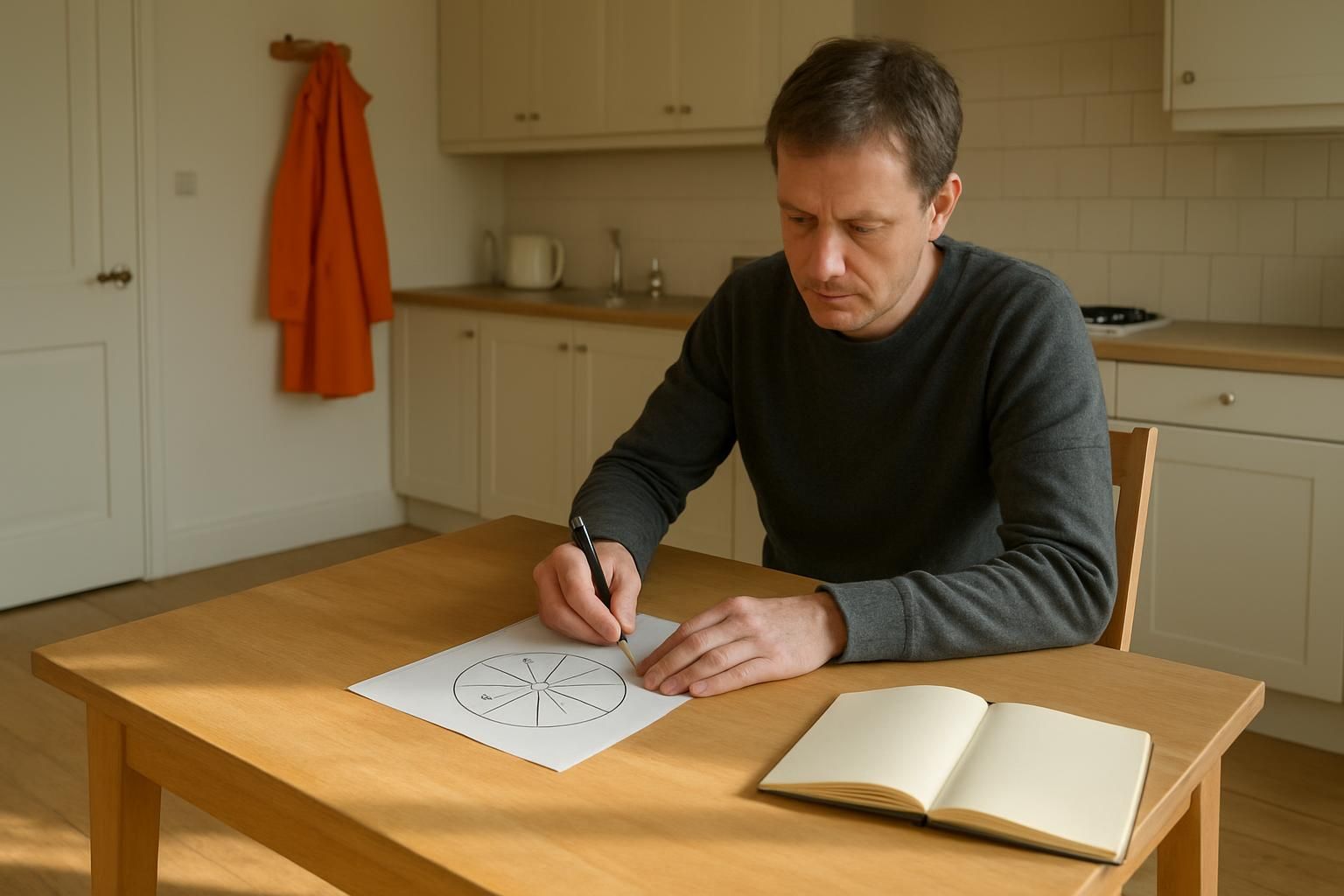
  • The Wheel of Life Exercise: 8 Areas, How to Score Them, and What to Do With the Result

    The Wheel of Life Exercise: 8 Areas, How to Score Them, and What to Do With the Result

    The wheel of life exercise is a coaching tool where you rate eight areas of your life from 1 to 10 for how satisfied you are right now, then plot the numbers on a circle to see the pattern. It takes about fifteen minutes, is a snapshot of satisfaction rather than a test, and works best when you also score where you want each area in ninety days.

    You draw a circle, divide it into eight slices, one per area, and mark a number on each slice. When you connect the marks, you get a shape instead of a straight line of numbers, and a shape is easier to read at a glance than a list. The tool is widely used by coaches as a starting conversation, not as a diagnosis: it tells you where you have put your attention and where you haven’t, nothing more. This is training, not therapy, and a low score on its own is not a problem to treat, just information to work with.

    The exercise is commonly attributed to Paul J. Meyer, a business trainer who is often credited with an early version of it. That attribution is repeated often enough that it is worth mentioning, but no single page confirms it beyond doubt, so take it as commonly reported rather than as settled history.

    Which 8 areas are on the wheel of life?

    The eight areas on the wheel of life cover the parts of daily life most people weigh when they ask themselves how things are going: work, money, health, family and friends, romance, personal growth, fun and recreation, and home environment. Eight is enough slices to see a real pattern and few enough that you can finish the exercise in one sitting.

    Different versions of the wheel use slightly different labels. Some combine family and friends into one slice called relationships, some split health into physical and mental. You can rename one area to fit your life, a parent might swap fun and recreation for something more specific, but keep the total at eight. More slices start to measure everything and mean nothing; fewer start to hide real differences between areas that actually feel different.

    Area What it covers in daily life One question before you score it
    Work What you do for most of your waking hours, paid or not Am I rating the work itself, or just today’s inbox?
    Money How you feel about what comes in, what goes out, and what’s saved Am I scoring my situation or my worry about it?
    Health Sleep, energy, movement, how your body actually feels day to day Is this about how I feel, or how I think I should look?
    Family and friends The people you did not choose for a job, chosen or given Which relationship is doing most of the lifting in this number?
    Romance A partner, or the absence of one, and how that sits with you Am I scoring the relationship or a comparison to someone else’s?
    Personal growth Learning, reading, anything that stretches how you think When did I last learn something that changed how I see things?
    Fun and recreation What you do purely because you enjoy it, no other reason How much of my week has nothing to do with being useful?
    Home environment The physical space you live in and how it feels to be in it Does my space help me or quietly drain me?

    How do you score each area from 1 to 10?

    Score each area for how satisfied you are right now, not for how well you think you are performing. A 1 means this area feels genuinely bad to you today, a 10 means you would not want to change a thing about it right now. There is no neutral correct middle, the number is yours.

    Score satisfaction, not performance: someone can work long hours and score work a 3 because it drains them, while someone working fewer hours scores it an 8 because it fits. Score today, not the average of the last year, the wheel is a snapshot, not a history.

    Go with your first number within about ten seconds and move to the next area. The first number is usually the honest one, and a long pause is often you negotiating with yourself about what you think the number should be.

    If you’re stuck between two numbers, take the lower one and write one line about why. That line is often more useful than the number itself, because it names exactly what is missing. Do all eight scores before you look at the overall shape, looking too early pulls later numbers toward matching the pattern instead of reflecting the area.

    The second score most people skip: where do you want this area to be in ninety days?

    Score each area twice, once for where it is now and once for where you want it in ninety days. Most versions of the wheel of life stop at the first number, which tells you how things feel but nothing about where to put your effort next.

    Ninety days is long enough that something can actually change and short enough that the goal stays real instead of turning into someday. A wanted score for a given area does not have to be a 10, and for several areas it probably shouldn’t be. Wanting everything at a 10 at once is not a plan, it’s a wish list.

    The gap between the two numbers, now and wanted, is the real output of the exercise. A 4 that you want to move to a 5 is a different task than a 4 you want to move to a 9, and both are more useful to know than the 4 alone. Not every low score needs fixing: a 3 in an area you have made peace with, by choice, is information too, not a flaw to correct.

    What do you do with the result once you have scored all eight?

    Once all eight areas have a now score and a wanted score, look at the biggest gap, not the lowest score. A 3 you want to stay a 3 matters less than a 6 you want to be a 9, even though the 3 looks worse on paper.

    1. Find the biggest gap. Compare now and wanted across all eight areas and find where the distance is largest.
    2. Pick one area, not three. One area you can actually work with beats three you will abandon by next week.
    3. Write one sentence about ninety days from now. Describe, in one plain sentence, what that area would look like if the gap closed.
    4. Turn the complaint into a want. What you are tired of usually points straight at what you actually want; say the want out loud instead of the complaint.
    5. Take one step within twenty-four hours. Something small and concrete, not a plan, an action you can finish today or tomorrow.
    6. Set a weekly check-in. Same day each week, five minutes, just to ask whether the step from last week actually happened.

    If you are not sure which area matters most once you see the gaps, it can help to find your core values first, since a gap that touches something you genuinely value pulls harder than a gap that doesn’t.

    Wheel of life questions to ask yourself about each area

    A number alone is easy to argue with later, a few honest questions make it harder to fool yourself. For each area, ask what made this a 6 and not a 4, what would make it one point higher, and whose standard you are actually scoring against, yours or someone else’s.

    For areas you scored high, ask what keeps this score high and whether it could slip without you noticing. High scores can hide neglect just as easily as low scores do, the difference is nobody checks on a high score.

    For any area you avoided scoring, or rushed through, ask yourself why. An area that is hard to even look at directly is often telling you something a quick number cannot.

    Why a balanced wheel is not the goal

    An even wheel of all 6s is not better than an uneven wheel with a 9 and a 3 on it, because balance is not the point of the exercise, honesty is. A flat set of middling numbers can mean genuine contentment, or it can mean nobody has looked closely at anything in a while.

    A season of deliberate imbalance can be a real choice rather than a failure. Someone building a business, finishing a degree, or raising a newborn is often leaning hard into one or two areas on purpose, and that’s not the same as a wheel that is imbalanced by accident.

    Balance is worth thinking about across a year, not across a single Tuesday. What the shape of the wheel actually tells you is where your attention has gone and where it hasn’t, and that’s a more useful read than whether the shape looks round.

    Common mistakes that make the wheel of life exercise useless

    The most common mistake is scoring the life you think you should have instead of the one you actually have. A score built on an imagined standard gives you a shape that doesn’t match reality, and a plan built on that shape won’t fit either.

    • Doing the exercise, feeling something, and changing nothing afterward.
    • Picking all eight low-scoring areas to work on at once instead of one.
    • Redoing the wheel every week instead of on a ninety-day rhythm, which turns a thinking tool into a worry habit.
    • Treating a low score as a verdict about you as a person, rather than as information about one area at one point in time.

    If low scores come with lasting low mood, trouble sleeping, or ongoing anxiety, that belongs with a doctor or a therapist, not with a self-scoring exercise. The wheel can point you toward a direction to think about, it was never built to treat anything.

    Where to get a wheel of life template and do it now

    You can do the wheel of life exercise on paper right now: draw a circle, divide it into eight slices, label each one, and mark a number on each. Fifteen minutes and a pen is genuinely enough to get a useful first read.

    If you would rather have both scores, now and ninety days, kept somewhere you can come back to, you can start with the free wheel of life. It takes about fifteen minutes, costs nothing, and the result stays in your account so you can compare it later. You can also read more about the wheel of life as a tool before you dive in.

    The free wheel is the first step of the course Know what you want, which has three modules and fourteen short video lessons. Every lesson includes an exercise you fill in, and an AI coach reads what you wrote and asks follow-up questions until the answer is actually clear. You can change an answer and ask for feedback again, and the AI coach is included for twelve months with the course. If you’d rather start somewhere lighter than scoring eight areas, a 20-minute way to find out where you actually are is a gentler entry point, and for the bigger picture once you have a direction, there’s more on leading your life.

    How often should you redo the wheel of life?

    Redo the full wheel of life about every ninety days, the same window you used for your wanted scores. Ninety days is enough time for a real change to show up in a number without the exercise turning into a constant check on yourself.

    Between full rescores, a weekly check-in on the one area you picked is more useful than redoing all eight. Ask one question each week: did the step happen, and what’s the next one.

    When ninety days is up, compare the two wheels side by side and look at direction rather than the size of the change. A 4 that moved to a 5 in the area you chose is real movement, even though it looks small next to the other seven numbers that barely shifted.

    Frequently asked questions

    How long does the wheel of life exercise take?

    The wheel of life exercise takes about fifteen minutes if you score each of the eight areas once. Adding a second score for where you want each area in ninety days adds only a few more minutes, since you are working from the same list.

    What are the 8 areas of the wheel of life?

    A common set of eight areas is work, money, health, family and friends, romance, personal growth, fun and recreation, and home environment. Some versions use slightly different labels, and you can rename one area to fit your life as long as you keep the total at eight.

    What is a good score on the wheel of life?

    There is no universally good score, since the wheel measures your own satisfaction, not a standard you are compared against. A 7 that genuinely reflects how you feel is more useful than a 9 you gave yourself because you think that's what the number should be.

    Who invented the wheel of life?

    The wheel of life is commonly attributed to Paul J. Meyer, a business trainer often credited with an early version of the tool. That attribution is widely repeated rather than formally documented, so it's worth treating as commonly reported history rather than a settled fact.

    Can I do the wheel of life exercise on my own, without a coach?

    Yes, you can do it on your own with just paper, a circle divided into eight slices, and about fifteen minutes. A coach or guided version can help you ask better follow-up questions about each score, but the basic exercise needs no one else.

    What do I do if every area scores low?

    If every area scores low, pick the single biggest gap between where it is now and where you want it in ninety days, rather than trying to fix all eight at once. If low scores come with lasting low mood, sleep trouble, or ongoing anxiety, that belongs with a doctor or a therapist, not with a self-scoring exercise.

    Not sure what you want yet?

    The free wheel of life takes about fifteen minutes. You rate eight areas of your life, see where the gap is and keep the result. It is the first step of the course Know what you want, and it costs nothing.

    Start the free wheel of life

    This article was written with AI assistance and checked by Dustin van de Sande.

  • Wat is een levenswiel oefening en hoe doe je die? Stap voor stap in 15 minuten

    Wat is een levenswiel oefening en hoe doe je die? Stap voor stap in 15 minuten

    Een levenswiel oefening is een manier om je leven te overzien: je verdeelt het in acht gebieden, geeft elk gebied een cijfer van 1 tot 10 voor nu en voor over negentig dagen, en kijkt naar het patroon dat ontstaat. Het kost ongeveer vijftien minuten, is geen test of diagnose, en is een denkhulpmiddel, geen therapie.

    Het wiel laat je in één oogopslag zien waar je tevreden bent en waar niet. Het geeft geen uitslag en geen advies, het geeft je alleen een eerlijk overzicht om vanuit te denken. Veel mensen weten precies wat ze beu zijn, maar niet waar ze eigenlijk naartoe willen: dat is het gat dat deze oefening zichtbaar maakt. Je kunt het levenswiel gratis invullen, het kost geen betaling en de uitkomst blijft bewaard in je account.

    Welke 8 gebieden staan er in een levenswiel?

    De meest gebruikte indeling telt acht gebieden: werk, geld, gezondheid, relaties, gezin, persoonlijke groei, vrije tijd en woonomgeving. Sommige versies van het levenswiel gebruiken zeven of tien gebieden, en dat is geen fout: het gaat erom dat de gebieden jouw leven dekken, niet dat het er precies acht zijn.

    Je mag een gebied hernoemen of vervangen als het niet past. Iemand zonder kinderen schrapt bijvoorbeeld ‘gezin’ en zet er ‘vriendschappen’ voor in de plaats, en dat is prima zolang je bij acht blijft of er bewust van afwijkt.

    • Werk: voelt wat je dagelijks doet nog kloppend?
    • Geld: geeft je financiële situatie rust of onrust?
    • Gezondheid: hoe gaat het met je lijf en je energie?
    • Relaties: voel je je gezien in je relatie of je vriendschappen?
    • Gezin: hoe is het contact met de mensen om je heen thuis?
    • Persoonlijke groei: leer en ontwikkel je nog iets dat ertoe doet?
    • Vrije tijd: heb je tijd die echt van jou is?
    • Woonomgeving: voelt je plek rustig en passend?

    Scoor elk gebied zoals het nu werkelijk is, niet zoals het zou moeten zijn volgens jezelf of anderen. Dat onderscheid is het hele punt van de oefening: een eerlijk cijfer zegt meer dan een gewenst cijfer.

    Hoe vul je een levenswiel in? De oefening in 7 stappen

    Je kunt een levenswiel in ongeveer vijftien minuten invullen met alleen een vel papier of een scherm en een rustige plek. Hieronder staan de zeven stappen die je direct kunt volgen.

    1. Zet een kwartier apart. Leg je telefoon weg, dit werkt niet tussen twee meldingen door.
    2. Kies je acht gebieden. Gebruik de standaardlijst en pas er hooguit twee aan als dat nodig is.
    3. Geef elk gebied een cijfer van 1 tot 10 voor nu. Neem per gebied maximaal tien seconden, het eerste cijfer dat in je opkomt is meestal het bruikbaarste.
    4. Zet er een tweede cijfer naast. Waar wil je over negentig dagen staan op dit gebied?
    5. Bekijk het verschil per gebied. Niet het laagste cijfer is het belangrijkst, maar het grootste verschil tussen nu en over negentig dagen.
    6. Kies één gebied, niet drie. Acht gebieden tegelijk aanpakken werkt niet, één wel.
    7. Schrijf één eerste stap op die binnen vierentwintig uur past. Klein genoeg om vandaag of morgen te doen, groot genoeg om iets te verschuiven.
    Levensgebied De vraag die je jezelf stelt Cijfer nu / over 90 dagen
    Werk Voelt wat je dagelijks doet nog kloppend?
    Geld Geeft je financiële situatie rust of onrust?
    Gezondheid Hoe gaat het met je lijf en je energie?
    Relaties Voel je je gezien in je relatie of vriendschappen?
    Gezin Hoe is het contact thuis?
    Persoonlijke groei Leer je nog iets dat ertoe doet?
    Vrije tijd Heb je tijd die echt van jou is?
    Woonomgeving Voelt je plek rustig en passend?

    Hoe scoor je eerlijk, zonder jezelf een cijfer te geven dat je niet voelt?

    Een 6 of een 8 gaat over tevredenheid, niet over prestatie. Een 8 voor gezondheid betekent niet dat je elke dag sport, het betekent dat jij je daar tevreden bij voelt.

    Vergelijk niet met anderen, vergelijk met wat jij zelf wilt. Iemands 9 voor werk zegt niets over jouw 5, want jullie meten tegen een ander ijkpunt.

    Als alles rond een 6 of 7 uitkomt, kijk dan niet naar de cijfers zelf maar naar de verschillen tussen nu en over negentig dagen: daar zit meestal meer beweging dan in de cijfers op zich. Kun je bij een gebied helemaal geen cijfer kiezen, schrijf dan op wat je tegenhoudt in plaats van toch een getal te forceren. Een lage score is informatie, geen oordeel over jou als persoon.

    Hoe ziet een ingevuld levenswiel eruit? Een voorbeeld om te herkennen

    Stel je iemand voor die werk een 4 geeft en wil groeien naar een 7, gezondheid een 6 geeft en wil groeien naar een 6 (geen verandering gewenst), en vrije tijd een 3 geeft met de wens naar een 8. Dit is een illustratie, geen echte persoon of casus.

    In dit voorbeeld lees je het patroon niet af aan het laagste cijfer, maar aan het grootste verschil: vrije tijd springt eruit met vijf punten verschil, dat is waarschijnlijk waar de meeste energie zit om iets te veranderen. Werk heeft ook beweging nodig, gezondheid voorlopig niet.

    Een ‘rond’ wiel, waarbij alle gebieden hetzelfde cijfer hebben, is geen doel op zich. Het gaat niet om balans als getal, het gaat om weten waar de beweging zit. Twee lage gebieden hangen trouwens vaak samen: weinig vrije tijd en een laag cijfer voor relaties komen bijvoorbeeld vaak samen voor, omdat tijd voor jezelf en tijd voor anderen uit dezelfde pot komen.

    Wat doe je met de uitkomst? Van cijfers naar één eerste stap

    Kies één gebied voor de komende negentig dagen, niet meer. Schrijf daar één zin bij over hoe dat gebied er over negentig dagen uitziet, concreet genoeg om te herkennen als het zover is.

    Bepaal daarna een eerste stap die binnen vierentwintig uur past en klein genoeg is om vandaag te doen. Zet een vaste wekelijkse check van vijf minuten in je agenda om te kijken of je nog op koers ligt.

    Let op het verschil tussen ‘weg van’ iets en ‘naar’ iets toe. ‘Ik wil minder moe zijn’ is een weg-van wens, ‘ik wil om negen uur naar bed om uitgerust wakker te worden’ is een naar-toe doel. Dat verschil is precies het werk van deze oefening.

    Wanneer herhaal je het levenswiel, en wat zie je dan?

    Vul het levenswiel opnieuw in na negentig dagen en leg de nieuwe scores naast de oude. Bekijk de oude scores pas nadat je opnieuw hebt gescoord, anders laat je je onbewust sturen door wat je eerder al had ingevuld.

    Als een cijfer daalde terwijl je er wel aan werkte, betekent dat niet dat de oefening niet werkt. Het betekent vaak dat je verwachtingen zijn meegegroeid, of dat iets anders in die periode meer aandacht vroeg. Als je je scores bewaart en over negentig dagen vergelijkt, zie je dat verschil direct naast elkaar, zonder dat je het uit je geheugen hoeft te reconstrueren.

    Welke fouten maken mensen bij het levenswiel het vaakst?

    De vijf meest voorkomende fouten zijn hieronder op een rij gezet, zodat je ze kunt herkennen voordat je er zelf in trapt.

    • Alle acht gebieden tegelijk willen verbeteren. Kies er één, de rest wacht.
    • Scoren zoals je zou willen zijn. Dat geeft een mooi plaatje, maar geen bruikbaar startpunt.
    • Het wiel invullen en er daarna niets mee doen. Zonder een eerste stap blijft het bij inzicht zonder beweging.
    • Het cijfer te lang overdenken. Na tien seconden wordt het meestal minder eerlijk, niet eerlijker.
    • Een gebied overslaan omdat het pijnlijk is. Schrijf in plaats daarvan op wat je tegenhoudt om er wel een cijfer bij te zetten.

    Wanneer is het levenswiel niet het juiste hulpmiddel?

    Bij somberheid die aanhoudt, burn-outklachten, angst of trauma hoort professionele hulp, niet een oefening. Het levenswiel is een denkhulpmiddel voor overzicht, geen behandeling, en vervangt nooit het gesprek met een huisarts of therapeut.

    Thuisarts.nl beschrijft wanneer somberheid reden is om hulp te zoeken, bijvoorbeeld als het langer dan twee weken duurt of je dagelijks functioneren raakt (bron: thuisarts.nl, zie citaties). Voel je dat dit op jou van toepassing is, laat het wiel dan gewoon even liggen en zoek eerst dat gesprek.

    Waar kun je het levenswiel gratis invullen?

    Je kunt het levenswiel gratis invullen bij Coach Kontra, de oefening duurt ongeveer vijftien minuten, kost geen betaling en de uitkomst blijft bewaard in je account. Je zet er direct scores in voor nu en voor over negentig dagen, precies zoals in de stappen hierboven.

    Dit is de eerste stap van de cursus Weten wat je wilt, die bestaat uit drie modules met veertien korte videolessen. Elke les heeft een oefening die je rechtstreeks in de les invult, en een AI-coach leest je antwoord en vraagt door tot het helder is. De AI-coach is twaalf maanden inbegrepen bij een cursus.

    Frequently asked questions

    Hoeveel tijd kost een levenswiel oefening?

    Een levenswiel oefening kost ongeveer vijftien minuten. Je geeft acht gebieden elk een cijfer voor nu en voor over negentig dagen, en kiest daarna één eerste stap. Langer dan een kwartier is meestal een teken dat je te lang nadenkt over elk cijfer.

    Welke 8 gebieden horen er standaard in een levenswiel?

    De meest gebruikte acht gebieden zijn werk, geld, gezondheid, relaties, gezin, persoonlijke groei, vrije tijd en woonomgeving. Je mag een gebied hernoemen of vervangen als het niet past bij jouw leven. Sommige versies gebruiken zeven of tien gebieden, dat is geen fout.

    Hoe geef je een eerlijk cijfer in het levenswiel?

    Scoor een gebied zoals het nu werkelijk is, niet zoals het zou moeten zijn. Neem maximaal tien seconden per gebied, het eerste cijfer dat in je opkomt is meestal het bruikbaarste. Vergelijk met wat jij zelf wilt, niet met iemand anders.

    Moet je levenswiel rond worden?

    Nee, een rond wiel is geen doel. Het gaat niet om gelijke cijfers op elk gebied, maar om zien waar het grootste verschil zit tussen nu en over negentig dagen. Dat verschil wijst je naar het gebied om mee te beginnen.

    Hoe vaak vul je een levenswiel in?

    Vul het levenswiel opnieuw in na ongeveer negentig dagen. Bekijk je oude scores pas nadat je opnieuw hebt gescoord, zodat de nieuwe cijfers niet door de oude worden gekleurd. Bewaarde uitkomsten maken die vergelijking makkelijker.

    Kun je het levenswiel alleen doen of heb je een coach nodig?

    Je kunt het levenswiel helemaal alleen invullen met een vel papier of de gratis online versie. Wil je dat iets je antwoorden leest en doorvraagt tot ze helder zijn, dan doet de AI-coach in de cursus Weten wat je wilt dat bij elke oefening.

    Weet je nog niet wat je wilt?

    Het gratis levenswiel kost ongeveer een kwartier. Je geeft acht levensgebieden een cijfer, ziet waar het schuurt en bewaart de uitkomst. Het is de eerste stap van de cursus Weten wat je wilt, en het kost niets.

    Begin met het gratis levenswiel

    Sources

    Dit artikel is geschreven met hulp van AI en gecontroleerd door Dustin van de Sande.

  • “I Don’t Know What I Want”: A Step-by-Step Way to Find Out, Starting With What You’re Tired Of

    “I Don’t Know What I Want”: A Step-by-Step Way to Find Out, Starting With What You’re Tired Of

    Start from what you are tired of: list it, name its opposite, check each want against three values you choose, rate eight life areas now and in ninety days, pick one direction, write it as one sentence, then take a step within twenty-four hours. This six-step method takes about two hours over a week, and it is training, not therapy.

    Not knowing what you want is common, and it is usually a sign of too many options and too much borrowed language, not a personal flaw. You have heard enough advice, read enough lists, scrolled enough feeds, that your own voice is buried under other people’s answers. The fix is not more inspiration. It is a sequence you can actually run.

    Why does “away from” come before “toward”?

    Irritation is specific data, and a vision statement usually is not. When you say “I’m tired of back to back meetings,” you are describing something real you noticed today. When you try to write “my purpose is to inspire others,” you are usually reaching for language you picked up somewhere, not something you actually felt.

    Every “I’m tired of” sentence contains a hidden standard. If you are tired of being interrupted, you value focus. If you are tired of vague feedback, you value clarity. The complaint is not the end point, it is a clue pointing at something you already care about.

    Away-from motivation gets you moving, but it stops the moment the discomfort drops below a certain level. That is why people quit a job they hated and land in another one just like it: they moved away from something without ever naming what they were moving toward. Naming the opposite is a tool for thinking clearly, not proof that you have found the right answer yet.

    Step 1: Write the tired-of list (10 minutes)

    Set a timer for ten minutes and write every sentence that starts with “I’m tired of…” without editing or explaining. Aim for at least fifteen lines, and let small annoyances in alongside the big ones: a chaotic inbox counts as much as a job you dread.

    When the timer stops, read the list back and mark the three lines you felt in your body as you wrote them, a tightness in the chest, a sigh, a short laugh of recognition. Those three carry more information than the rest of the list combined. Do not try to solve anything yet, just notice which ones land.

    Step 2: Turn each complaint into its opposite (15 minutes)

    Take each line and rewrite it in the format “what I want instead is…”. “I’m tired of back to back meetings” becomes “what I want instead is two hours of uninterrupted work each morning.”

    The first version of the opposite is almost always an absence: less email, fewer meetings, less noise. Push past that to a presence, what would actually be there instead. Imagine someone who is tired of being the last to leave the office every night; their first answer is “less overtime,” but pushed further it becomes “I want to be the one who leaves at a normal hour and still trusts the work got done.” Ask two follow-up questions for each item: what would that give you, and what would you see yourself doing on an ordinary Tuesday if you had it. This guide on how to turn what you do not want into a goal walks through the same conversion in more depth.

    Step 3: Check it against what you actually value (20 minutes)

    Pick five words that describe how you want to work and live, then cut the list down to three. Writing five is easy, cutting to three forces you to choose between things that sound equally nice on paper.

    Test each wanted item from step two against those three words: does it genuinely serve one of them, or did it arrive from a parent’s expectation, a job title, or something you saw in a feed. Ask yourself plainly, whose voice is actually in this sentence. If you cannot answer that question for an item, set it aside rather than force it. For a fuller version of this filter, a 30-minute core values exercise goes through the same cut from five words to three with more prompts.

    Step 4: Rate your eight areas of life, now and in ninety days (15 minutes)

    The wheel of life asks you to score eight areas of life, such as work, health, relationships and money, twice: once for where you are now, and once for where you would want to be in ninety days. It takes about fifteen minutes, costs nothing, and the result is kept in your account so you can come back to it.

    The score itself is not the useful part. The gap between the two numbers in each area is: a two-point gap in one area and a six-point gap in another tells you where your attention actually wants to go, even before you have words for it. If you have not done this yet, it is the honest place to start before the rest of this method, and if a full stock-take of where you stand feels like the real first move, a 20-minute check on where you actually are is built for that.

    Step How long it takes The question you answer
    1. Tired-of list 10 minutes What am I actually tired of right now
    2. Name the opposite 15 minutes What do I want instead of this
    3. Check against values 20 minutes Does this want serve what I actually value
    4. Wheel of life 15 minutes Where is the gap between now and ninety days from now
    5. Choose one direction 20 minutes Which one can I actually start this week
    6. Write and start 10 minutes, then ongoing What is the smallest first step I can take today

    Step 5: Choose one direction when you have many ideas

    A want you cannot start this week is a theme, not a goal, and most people stuck here have too many ideas rather than none. Run every candidate through three screens: energy (does thinking about it make you want to act or want to lie down), evidence (have you already done any small piece of it before), and cost (what are you actually willing to give up for it, time, comfort, or certainty).

    Ask the goal behind the goal for your top two or three candidates: what would having this actually make possible for you. Two different wants sometimes point at the same underlying goal, which makes the choice easier. Deciding not to pursue the other four right now is part of the method, not a loss, and it is usually the step people skip because it feels like closing doors.

    Step 6: Write it as one sentence and take a step in twenty-four hours

    Write the chosen direction as one sentence: what you will do, by when, and in a form someone else could actually see or verify. “I want more balance” is not a sentence you can act on; “I will apply to two roles with no evening calls by the end of next month” is.

    The first step has to be small enough to do today and must not require anyone’s permission: looking up one job listing, sending one message, blocking one hour on your calendar. Set one weekly check-in at a fixed time to see what actually happened, and tell one other person what you are doing, since saying it out loud tends to make it more real than keeping it private. For the exact phrasing of the sentence itself, write a goal you actually want covers the wording in more detail, and if the direction you landed on is really a career question, find work that fits you picks up from here.

    How do you know if what you wrote is actually what you want?

    Run three checks on the sentence you wrote. Would you still want it if no one else ever knew you achieved it. Do you want the work itself, or only the result at the end of it. Does it still sound right after a genuinely bad week, or only on a good day.

    If the answer to any of these is no, change one word at a time rather than rewriting the whole sentence. Swap the deadline, swap the scale, swap who it is visible to, and test again. Changing your mind after a test like this is the method doing its job, not a sign you failed at the exercise.

    What to do when this feels heavier than indecision

    If you cannot feel interest in anything, if your sleep or appetite has changed, or if you are having thoughts of harming yourself, this belongs with a doctor or a therapist, not with a self-development exercise. These steps are training for thinking more clearly about direction, they are not treatment, and no technique here is a substitute for professional care. If any of that describes where you are, please reach out to a licensed professional before working through the rest of this article.

    Where this method sits next to the books people usually recommend

    As an Amazon Associate we earn from qualifying purchases. Some links in this article are affiliate links: if you buy through them we earn a small commission, at no extra cost to you.

    Books on this topic are usually frameworks you read and reflect on; this is a sequence with time boxes you can run this week with a pen and a timer. Both are useful, they just do different jobs. If you want a fuller framework to sit alongside the steps above, Designing Your Life is a genuinely useful one, built around treating your life like a design problem rather than a single decision to get right. Frameworks like that are tools for thinking, not evidence of what will work for you specifically, and the real test is still whether you actually run the exercise rather than just reading about it.

    What the course adds if you want to keep going

    If you want a structured way to keep going after these six steps, Know what you want covers the same ground with three modules and fourteen short video lessons. Every lesson has an exercise you fill in inside the lesson, and an AI coach reads your answer and asks follow-up questions until it is clear, and you can change an answer and ask for feedback again whenever you want. The AI coach is included for twelve months with the course. The wheel of life from step four is free, takes about fifteen minutes, and is the honest place to start if you have not done it yet.

    Frequently asked questions

    How do I find out what I want when I only know what I don't want?

    Start by listing everything you are tired of for ten minutes, then rewrite each line as its opposite: what you want instead. Check each rewritten want against two or three values you choose for yourself, since that filters out wants that are really someone else's expectations. This turns a list of complaints into a short list of real candidates within about an hour.

    Why do I struggle to figure out my purpose in life?

    Purpose is usually easier to approach through specific, lived irritation than through an abstract statement, because irritation is something you actually felt and a purpose statement often is not. Most people who feel stuck have too many borrowed ideas about what they should want, not a lack of inner life. Working from what you are tired of toward a concrete ninety-day picture tends to produce clearer results than trying to write a purpose statement directly.

    What questions should I ask myself to find direction?

    Useful questions include: what am I tired of right now, what would I want instead, whose voice is actually in that want, and what would a Tuesday look like if I had it. Also ask what the goal behind the goal is, meaning what having this would actually make possible for you. These questions work better written down with a timer than thought about in passing.

    How long does it take to figure out what you want in life?

    The six-step method described here takes roughly two hours total, spread across a week rather than done in one sitting. That covers the tired-of list, naming the opposite, checking it against your values, rating eight areas of life, choosing one direction, and writing it as a sentence with a first step. It will not answer every question about your life, but it reliably produces one clear direction and a next action.

    What if I want too many things at once?

    Wanting many things usually means you have themes rather than goals you can start this week, which is a different problem than not knowing what you want at all. Run each idea through three screens: your energy for it, whether you have any evidence you have already started a piece of it, and the cost you are genuinely willing to pay. Choosing one direction and setting the others aside for now is part of the method, not a failure to decide.

    Is it normal to not know what you want at 30, 40 or 50?

    Yes, this is common at every one of those ages and is not a sign that something is wrong with you. It usually means you have accumulated more options, more advice, and more other people's expectations than you have had time to sort through. A structured process that starts from what you are tired of tends to cut through that faster than waiting for clarity to arrive on its own.

    Not sure what you want yet?

    The free wheel of life takes about fifteen minutes. You rate eight areas of your life, see where the gap is and keep the result. It is the first step of the course Know what you want, and it costs nothing.

    Start the free wheel of life

    This article was written with AI assistance and checked by Dustin van de Sande.