
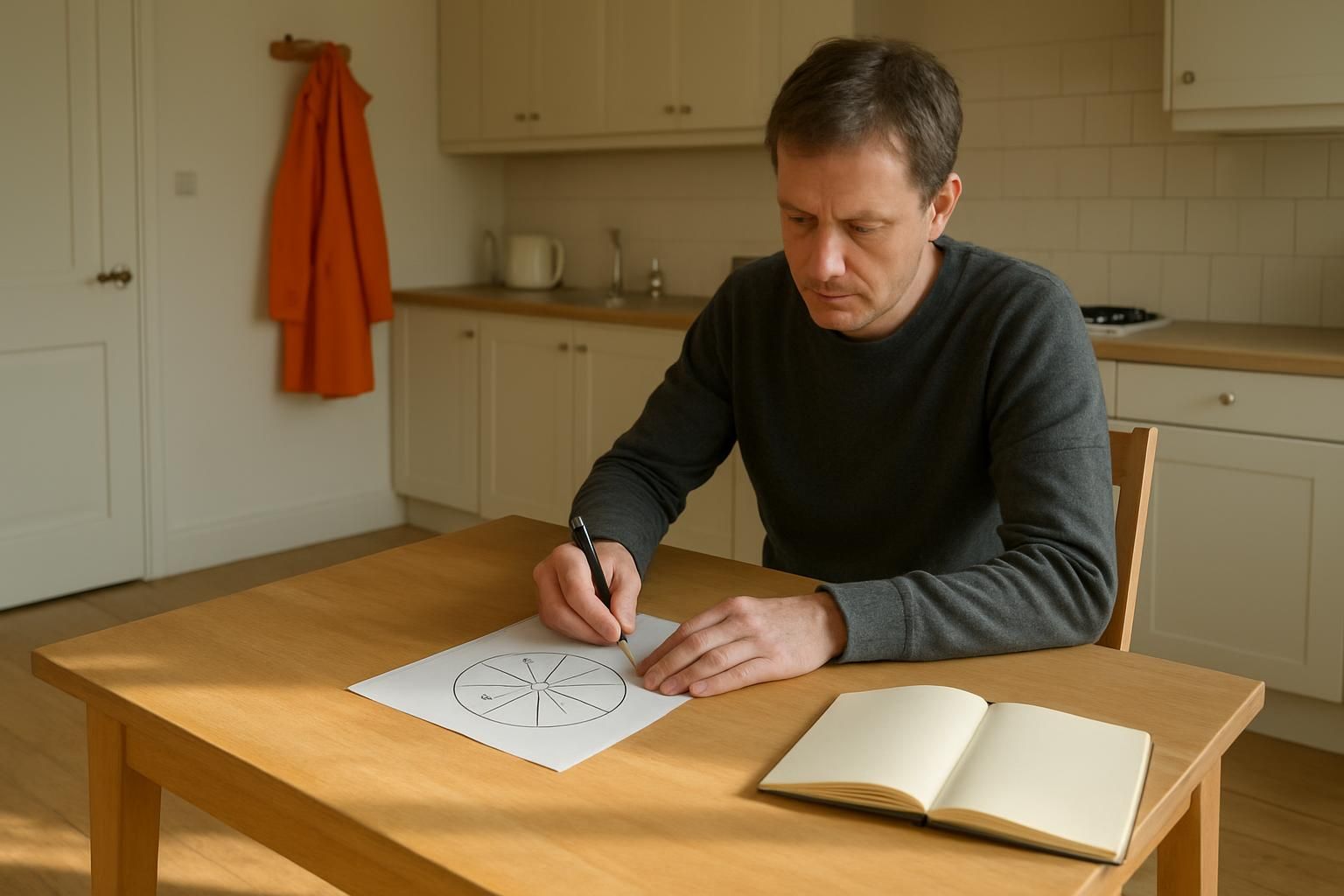
You rate eight areas of your life from 1 to 10 for how satisfied you are right now, then rate the same eight areas again for where you would honestly like them in ninety days. The gap between the two numbers, not the lowest score, tells you which one area to work on and turn into a small first step.
What is the wheel of life exercise, in one paragraph?
The wheel of life is a self-rating exercise where you score eight areas of your life on a scale from 1 to 10, based on how satisfied you feel in each one right now. It is commonly used as a coaching tool, not a test or a diagnosis, and it does not measure anything outside your own opinion of your own life. Mindtools describes it as a widely used tool for this kind of self-assessment. Done honestly, it takes about fifteen minutes. The score itself is not the point. It is a starting point for one question: where is the gap between where you are and where you would like to be.
What are the 8 areas of life you rate?
Most versions of the wheel use some form of these eight areas: work or career, money, health, relationships or family, friends and social life, personal growth, fun and recreation, and your living environment. Different versions label these slightly differently, and that is fine. If one of the labels does not fit your life, rename it, but keep eight areas so the picture stays comparable over time.
Money and health show up here as two areas to rate for satisfaction, nothing more. This article does not advise you on either one. If a low score in either area points toward a decision with real financial stakes or a medical concern, that decision belongs with a licensed professional, not with a self-rating exercise.
How do you score each area without overthinking it?
Score how satisfied you feel right now, not how the area looks from the outside. A job that looks impressive on paper can score a 3 if it leaves you drained, and a quiet life can score an 8 if it genuinely fits you. Give yourself about thirty seconds per area and write down the first number that comes to mind. The second number you think of is usually the one trying to make you look better, not the one that is true.
Decide for yourself what a 10 means in each area. There is no universal definition, and it does not need to match anyone else’s. If two numbers feel equally right, take the lower one. The lower number is more often the honest one, and the exercise only works if the numbers are honest.
Why you rate each area twice: now and ninety days from now
The second score is what makes this exercise useful instead of just a snapshot. After you score each area as it stands today, go back through the same eight areas and write the score that would feel honest and good enough ninety days from now. Not a fantasy number, a realistic one.
Ninety days is short enough to picture clearly and long enough for one thing to actually change. A target of 10 in every area usually means you have not actually chosen anything yet. It is easier to want everything than to decide what matters most for the next three months.
| Area of life | Rate it now (1-10) | Honest target in 90 days |
|---|---|---|
| Work or career | _ | _ |
| Money | _ | _ |
| Health | _ | _ |
| Relationships or family | _ | _ |
| Friends and social life | _ | _ |
| Personal growth | _ | _ |
| Fun and recreation | _ | _ |
| Living environment | _ | _ |
What do your scores actually tell you?
A low score is information, not a failing. It tells you that one part of your life is not matching what you want from it right now, and nothing more than that. A flat wheel of 6s across the board is not automatically better than a wheel with a 9 next to a 3. Flat and even is not the same as satisfied.
The real signal is the gap between your now score and your ninety day score in each area, not the lowest number on the page. A 3 with a target of 4 is telling you something different than a 3 with a target of 8. An area you genuinely do not care about right now can stay low on purpose, and that is a decision, not a problem to fix.
The wheel of life questions to sit with after you score
The scoring takes fifteen minutes. The questions you sit with afterward are where the actual thinking happens. Try these, one at a time:
- Which gap actually bothers you, and which one just looks bad on paper?
- If you moved one area up by a single point, what would be different in a normal Tuesday?
- Who, if anyone, would notice if this area improved?
- Which low score are you willing to leave low for now, without guilt?
- What have you been calling a problem here that is actually just a season?
- If you could only work on one area for the next ninety days, which one would you pick?
Why ‘balance’ is the wrong goal for most people
Equal scores across all eight areas is not the goal of this exercise, even though it is sometimes called a life balance wheel. Most lives move through seasons where some areas are deliberately quiet: a demanding stretch at work, a new baby, a health recovery, a move. Letting an area sit low on purpose during a season like that is a choice, not a compromise you should feel bad about.
Choosing one area to focus on for ninety days, and letting the others hold steady, is a decision most people avoid because it feels like giving something up. It is not giving anything up. It is picking where your attention actually goes instead of spreading it thin enough that nothing moves. No wheel looks even for long, and a lopsided one is not a verdict on how well you are doing.
How to turn one low score into a first step you take within 24 hours
Pick one area, not three. Trying to fix every low score at once is the most common way this exercise goes nowhere. Name what you want more of in that area, not just what you are tired of: ‘away from exhausted’ becomes ‘toward one evening a week with no screen after 8pm,’ which is something you can actually act on.
Make the first step small enough to do within twenty-four hours. If the area is friends and social life, the first step is not ‘rebuild my social life,’ it is ‘text one person and suggest a specific day.’ Then set one weekly check-in, a fixed day and time, to re-read the number and ask whether it moved.
As an illustration: imagine someone whose work score is a 4 now with a target of 7. Their first step within twenty-four hours might be blocking one hour on Friday to update a resume, nothing bigger. The weekly check-in is not about whether the job changed yet. It is about whether the one step actually happened.
How often should you redo the wheel of life?
Every ninety days is enough for most people, which conveniently matches the window the second score is already built around. Re-score before you look at your old numbers, then compare the two sets side by side. Looking at the old numbers first tends to pull your new scores toward what you expect to see rather than what is true.
If nothing moved after ninety days, that is useful information too: it usually means the first step was too big, too vague, or aimed at an area you did not actually care about. Keep a simple record of each round so comparison is possible. Without a record, you are relying on memory, and memory flatters you more than the numbers do.
When the wheel of life is not the right tool
This is a self-development exercise, not therapy, and it was never built to diagnose anything. If your low scores involve depression, anxiety, trauma, burnout, or thoughts of self-harm, that belongs with a doctor or a licensed therapist, not with a rating scale. Questions about money that involve real financial decisions belong with a licensed financial adviser, and questions about health belong with a medical professional.
None of this means you have to choose between the exercise and professional support. The wheel of life can sit alongside therapy, medical care, or financial advice. It simply does not replace any of them, and no article should suggest otherwise.
Where to do your wheel of life and what comes after
You can do the free wheel of life in about fifteen minutes, with no payment, and your result stays saved in your account so you can come back to it. It is the first step of Coach Kontra’s course, Know what you want, which has three modules and fourteen short video lessons. Each lesson has an exercise you fill in, and an AI coach reads your answer and asks follow-up questions until it is actually clear, not just finished. The AI coach is included for twelve months with the course.
If your wheel keeps coming back to the same conclusion, that the real issue is not one area but a lack of direction overall, the article on leading your life goes further into that. Otherwise, the fastest way to see where you actually stand is to start with the free wheel of life rather than keep reading about it.
Frequently asked questions
How do you complete the wheel of life?
You rate eight areas of your life, such as work, money, health, relationships, friends, personal growth, fun, and living environment, from 1 to 10 for how satisfied you feel right now. Then you rate the same eight areas a second time for where you would honestly like them in ninety days. The gap between the two scores in each area is what you act on, not the score itself.
What are the 8 elements of a balanced life?
Most versions of the wheel of life use work or career, money, health, relationships or family, friends and social life, personal growth, fun and recreation, and living environment. The exact labels vary between versions and you can rename any of them to fit your own life. What matters is keeping eight areas so your picture stays comparable over time.
How long does the wheel of life exercise take?
Done honestly, the exercise takes about fifteen minutes: roughly thirty seconds per area for each of the two rounds of scoring. The thinking that follows, sitting with the questions the scores raise, can take longer, and that part is worth the extra time.
Do you need a wheel of life template to do this?
No template is required. A sheet of paper with eight areas listed and two columns, one for now and one for ninety days from now, is enough to do the exercise properly. If you want it done for you with a saved result, the free wheel of life does this in about fifteen minutes with no payment.
What should you do if every area scores low?
Pick one area to work on for the next ninety days rather than trying to fix all of them at once. If the low scores point toward something heavier, such as ongoing low mood, anxiety, or burnout, that pattern belongs with a doctor or a licensed therapist rather than a self-rating exercise.
How often should you redo your wheel of life?
Every ninety days works well for most people, since that matches the window used for the second set of scores. Re-score first, before looking back at your old numbers, then compare the two sets to see what actually moved.
Not sure what you want yet?
The free wheel of life takes about fifteen minutes. You rate eight areas of your life, see where the gap is and keep the result. It is the first step of the course Know what you want, and it costs nothing.
Sources
This article was written with AI assistance and checked by Dustin van de Sande.
Ready to work on what you want?
Start with the free wheel of life: in fifteen minutes you see where you are and where you want to go. Want to turn that into a goal you will keep, with an AI coach? See the course Know what you want.