
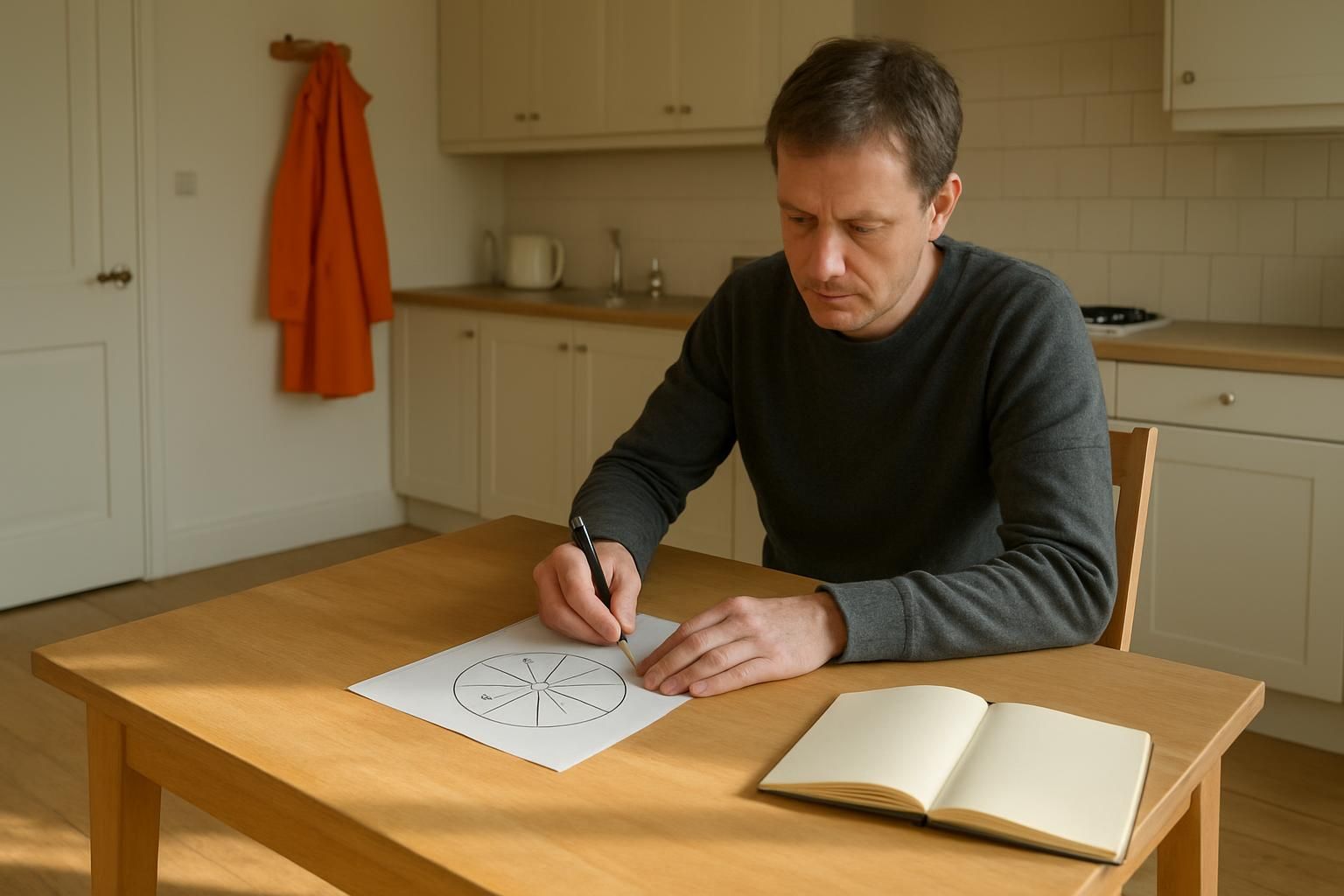
The wheel of life exercise is a coaching tool where you rate eight areas of your life from 1 to 10 for how satisfied you are right now, then plot the numbers on a circle to see the pattern. It takes about fifteen minutes, is a snapshot of satisfaction rather than a test, and works best when you also score where you want each area in ninety days.
You draw a circle, divide it into eight slices, one per area, and mark a number on each slice. When you connect the marks, you get a shape instead of a straight line of numbers, and a shape is easier to read at a glance than a list. The tool is widely used by coaches as a starting conversation, not as a diagnosis: it tells you where you have put your attention and where you haven’t, nothing more. This is training, not therapy, and a low score on its own is not a problem to treat, just information to work with.
The exercise is commonly attributed to Paul J. Meyer, a business trainer who is often credited with an early version of it. That attribution is repeated often enough that it is worth mentioning, but no single page confirms it beyond doubt, so take it as commonly reported rather than as settled history.
Which 8 areas are on the wheel of life?
The eight areas on the wheel of life cover the parts of daily life most people weigh when they ask themselves how things are going: work, money, health, family and friends, romance, personal growth, fun and recreation, and home environment. Eight is enough slices to see a real pattern and few enough that you can finish the exercise in one sitting.
Different versions of the wheel use slightly different labels. Some combine family and friends into one slice called relationships, some split health into physical and mental. You can rename one area to fit your life, a parent might swap fun and recreation for something more specific, but keep the total at eight. More slices start to measure everything and mean nothing; fewer start to hide real differences between areas that actually feel different.
| Area | What it covers in daily life | One question before you score it |
|---|---|---|
| Work | What you do for most of your waking hours, paid or not | Am I rating the work itself, or just today’s inbox? |
| Money | How you feel about what comes in, what goes out, and what’s saved | Am I scoring my situation or my worry about it? |
| Health | Sleep, energy, movement, how your body actually feels day to day | Is this about how I feel, or how I think I should look? |
| Family and friends | The people you did not choose for a job, chosen or given | Which relationship is doing most of the lifting in this number? |
| Romance | A partner, or the absence of one, and how that sits with you | Am I scoring the relationship or a comparison to someone else’s? |
| Personal growth | Learning, reading, anything that stretches how you think | When did I last learn something that changed how I see things? |
| Fun and recreation | What you do purely because you enjoy it, no other reason | How much of my week has nothing to do with being useful? |
| Home environment | The physical space you live in and how it feels to be in it | Does my space help me or quietly drain me? |
How do you score each area from 1 to 10?
Score each area for how satisfied you are right now, not for how well you think you are performing. A 1 means this area feels genuinely bad to you today, a 10 means you would not want to change a thing about it right now. There is no neutral correct middle, the number is yours.
Score satisfaction, not performance: someone can work long hours and score work a 3 because it drains them, while someone working fewer hours scores it an 8 because it fits. Score today, not the average of the last year, the wheel is a snapshot, not a history.
Go with your first number within about ten seconds and move to the next area. The first number is usually the honest one, and a long pause is often you negotiating with yourself about what you think the number should be.
If you’re stuck between two numbers, take the lower one and write one line about why. That line is often more useful than the number itself, because it names exactly what is missing. Do all eight scores before you look at the overall shape, looking too early pulls later numbers toward matching the pattern instead of reflecting the area.
The second score most people skip: where do you want this area to be in ninety days?
Score each area twice, once for where it is now and once for where you want it in ninety days. Most versions of the wheel of life stop at the first number, which tells you how things feel but nothing about where to put your effort next.
Ninety days is long enough that something can actually change and short enough that the goal stays real instead of turning into someday. A wanted score for a given area does not have to be a 10, and for several areas it probably shouldn’t be. Wanting everything at a 10 at once is not a plan, it’s a wish list.
The gap between the two numbers, now and wanted, is the real output of the exercise. A 4 that you want to move to a 5 is a different task than a 4 you want to move to a 9, and both are more useful to know than the 4 alone. Not every low score needs fixing: a 3 in an area you have made peace with, by choice, is information too, not a flaw to correct.
What do you do with the result once you have scored all eight?
Once all eight areas have a now score and a wanted score, look at the biggest gap, not the lowest score. A 3 you want to stay a 3 matters less than a 6 you want to be a 9, even though the 3 looks worse on paper.
- Find the biggest gap. Compare now and wanted across all eight areas and find where the distance is largest.
- Pick one area, not three. One area you can actually work with beats three you will abandon by next week.
- Write one sentence about ninety days from now. Describe, in one plain sentence, what that area would look like if the gap closed.
- Turn the complaint into a want. What you are tired of usually points straight at what you actually want; say the want out loud instead of the complaint.
- Take one step within twenty-four hours. Something small and concrete, not a plan, an action you can finish today or tomorrow.
- Set a weekly check-in. Same day each week, five minutes, just to ask whether the step from last week actually happened.
If you are not sure which area matters most once you see the gaps, it can help to find your core values first, since a gap that touches something you genuinely value pulls harder than a gap that doesn’t.
Wheel of life questions to ask yourself about each area
A number alone is easy to argue with later, a few honest questions make it harder to fool yourself. For each area, ask what made this a 6 and not a 4, what would make it one point higher, and whose standard you are actually scoring against, yours or someone else’s.
For areas you scored high, ask what keeps this score high and whether it could slip without you noticing. High scores can hide neglect just as easily as low scores do, the difference is nobody checks on a high score.
For any area you avoided scoring, or rushed through, ask yourself why. An area that is hard to even look at directly is often telling you something a quick number cannot.
Why a balanced wheel is not the goal
An even wheel of all 6s is not better than an uneven wheel with a 9 and a 3 on it, because balance is not the point of the exercise, honesty is. A flat set of middling numbers can mean genuine contentment, or it can mean nobody has looked closely at anything in a while.
A season of deliberate imbalance can be a real choice rather than a failure. Someone building a business, finishing a degree, or raising a newborn is often leaning hard into one or two areas on purpose, and that’s not the same as a wheel that is imbalanced by accident.
Balance is worth thinking about across a year, not across a single Tuesday. What the shape of the wheel actually tells you is where your attention has gone and where it hasn’t, and that’s a more useful read than whether the shape looks round.
Common mistakes that make the wheel of life exercise useless
The most common mistake is scoring the life you think you should have instead of the one you actually have. A score built on an imagined standard gives you a shape that doesn’t match reality, and a plan built on that shape won’t fit either.
- Doing the exercise, feeling something, and changing nothing afterward.
- Picking all eight low-scoring areas to work on at once instead of one.
- Redoing the wheel every week instead of on a ninety-day rhythm, which turns a thinking tool into a worry habit.
- Treating a low score as a verdict about you as a person, rather than as information about one area at one point in time.
If low scores come with lasting low mood, trouble sleeping, or ongoing anxiety, that belongs with a doctor or a therapist, not with a self-scoring exercise. The wheel can point you toward a direction to think about, it was never built to treat anything.
Where to get a wheel of life template and do it now
You can do the wheel of life exercise on paper right now: draw a circle, divide it into eight slices, label each one, and mark a number on each. Fifteen minutes and a pen is genuinely enough to get a useful first read.
If you would rather have both scores, now and ninety days, kept somewhere you can come back to, you can start with the free wheel of life. It takes about fifteen minutes, costs nothing, and the result stays in your account so you can compare it later. You can also read more about the wheel of life as a tool before you dive in.
The free wheel is the first step of the course Know what you want, which has three modules and fourteen short video lessons. Every lesson includes an exercise you fill in, and an AI coach reads what you wrote and asks follow-up questions until the answer is actually clear. You can change an answer and ask for feedback again, and the AI coach is included for twelve months with the course. If you’d rather start somewhere lighter than scoring eight areas, a 20-minute way to find out where you actually are is a gentler entry point, and for the bigger picture once you have a direction, there’s more on leading your life.
How often should you redo the wheel of life?
Redo the full wheel of life about every ninety days, the same window you used for your wanted scores. Ninety days is enough time for a real change to show up in a number without the exercise turning into a constant check on yourself.
Between full rescores, a weekly check-in on the one area you picked is more useful than redoing all eight. Ask one question each week: did the step happen, and what’s the next one.
When ninety days is up, compare the two wheels side by side and look at direction rather than the size of the change. A 4 that moved to a 5 in the area you chose is real movement, even though it looks small next to the other seven numbers that barely shifted.
Frequently asked questions
How long does the wheel of life exercise take?
The wheel of life exercise takes about fifteen minutes if you score each of the eight areas once. Adding a second score for where you want each area in ninety days adds only a few more minutes, since you are working from the same list.
What are the 8 areas of the wheel of life?
A common set of eight areas is work, money, health, family and friends, romance, personal growth, fun and recreation, and home environment. Some versions use slightly different labels, and you can rename one area to fit your life as long as you keep the total at eight.
What is a good score on the wheel of life?
There is no universally good score, since the wheel measures your own satisfaction, not a standard you are compared against. A 7 that genuinely reflects how you feel is more useful than a 9 you gave yourself because you think that's what the number should be.
Who invented the wheel of life?
The wheel of life is commonly attributed to Paul J. Meyer, a business trainer often credited with an early version of the tool. That attribution is widely repeated rather than formally documented, so it's worth treating as commonly reported history rather than a settled fact.
Can I do the wheel of life exercise on my own, without a coach?
Yes, you can do it on your own with just paper, a circle divided into eight slices, and about fifteen minutes. A coach or guided version can help you ask better follow-up questions about each score, but the basic exercise needs no one else.
What do I do if every area scores low?
If every area scores low, pick the single biggest gap between where it is now and where you want it in ninety days, rather than trying to fix all eight at once. If low scores come with lasting low mood, sleep trouble, or ongoing anxiety, that belongs with a doctor or a therapist, not with a self-scoring exercise.
Not sure what you want yet?
The free wheel of life takes about fifteen minutes. You rate eight areas of your life, see where the gap is and keep the result. It is the first step of the course Know what you want, and it costs nothing.
This article was written with AI assistance and checked by Dustin van de Sande.